
Question What is Petrified Wood?
Answer
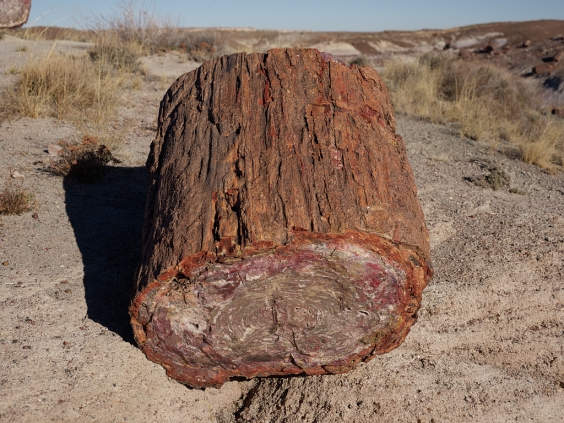
Wood becomes petrified when the organic material in the wood has been replaced by inorganic minerals, turning it to stone. i.e. a fossil.
Living beings are mostly made of organic molecules, which are molecules that contain carbon atoms bonded to hydrogen atoms. Carbon can form complex molecules, which is why carbon is an essential building block of life. Organic molecules decompose, or break down into smaller molecules readily. In contrast, inorganic materials don’t contain these carbon-hydrogen bonded molecules (although inorganic materials can contain carbon, as in carbon dioxide, for example) and aren’t broken down so easily.
The process by which petrified wood forms is called petrification. It involves taking the organic molecules in the wood and replacing them with inorganic materials. For petrified wood to form, some very specific conditions need to be met. First, a tree needs to perish in a place where it is quickly covered and protected from the air. This slows the decomposition of the tree, since oxygen in the air plays a major role in the process. If the tree remains covered this way for millions of years, petrification can occur.

Petrification is a type of fossilization. It happens when the organic materials of an organism are replaced by inorganic ones, essentially creating a stone replica. To be more specific, petrification happens through two processes called “permineralization” and “replacement.” Permineralization is when minerals are deposited in spaces (either pores or places where the organic material has broken down and washed away). Replacement occurs when the organic material is dissolved and completely replaced by minerals (elements or compounds that form a crystalline structure).
In organisms like animals, this most often happens to bones. Bones are very hard and contain calcium, a mineral, but bones are not entirely inorganic. The bones of a living organism with a skeleton are multi-layered and full of organic tissue. When that organism perishes in a place that is good for fossilization, the hard calcium of the bone holds the bone’s shape while the organic bits break down and are replaced by minerals from the surrounding mud.

For petrified wood, it’s the same idea. Trees are made up of cellulose and lignin. Wood is primarily made of cellulose, which gives wood its strength. Lignin acts as a binder for the cellulose. Being water-resistant, lignin helps the tree with water transport and is much more resistant to rot than cellulose. In petrification, the cellulose breaks down first, while the lignin takes longer, holding the shape of the future fossil.
Minerals from the surrounding mud seep into a tree’s pores, gradually replacing all the organic material in the tree, which crystallizes over the next million years. The mud around the tree also gets compressed over time and becomes sedimentary rock, encasing the wood that is still undergoing petrification.

The best conditions for petrification happen in areas where very fine sediment can be deposited efficiently, such as in rivers and floodplains. Sometimes, large numbers of trees end up stuck in the same area, often by floating downriver or getting caught in flood waters. Given enough time the groups of trees all petrify, creating petrified forests.
Eventually, if conditions become right again, the now petrified wood can become exposed on the Earth’s surface through processes of uplift and erosion. As the sedimentary rock surrounding the petrified wood wears away, the stronger stone that makes up the fossil is left behind.
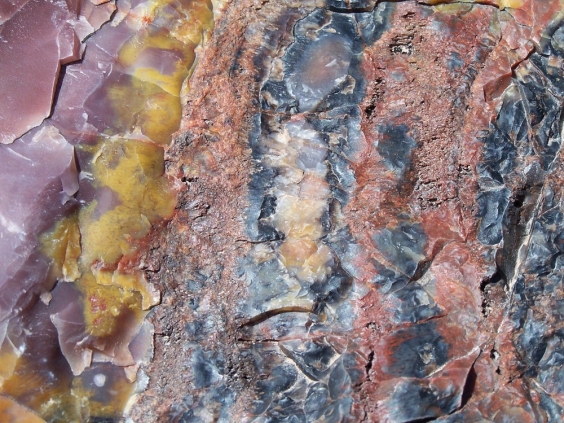
Petrified wood is most often made primarily of quartz (crystalized silica), with other trace minerals mixed in, giving the fossils their many layers of color. Petrified wood can also be made of other minerals such as calcite and pyrite, although it is less common.
Petrified facts:
- The petrified wood you can see at Arizona’s Petrified Forest National Park looks like sawed logs due to the motion of the earth and erosion. The minerals that replaced the wood are hard but brittle, so when the fossilized tree is put under too much stress from geologic movement, it snaps, breaking into chunks instead of splintering, as it would have in its woody form.
- Petrified wood has been found on every continent, even Antarctica!
- Petrified wood is usually only the trunk of a tree because the smaller, softer materials of branches and leaves degrade before they have a chance to become fossilized.
- At Arizona’s Petrified Forest National Park, the Rainbow Forest Museum houses a “conscience pile” of returned stolen rocks, along with letters of remorse from the individuals who took them.
- In Yellowstone National Park there are trees that became fossilized while standing upright, after being buried by volcanic ash.
Published: 12/15/2025. Author: Science Reference Section, Library of Congress