
Espionage
The text panel in front of you reads:
During the American Revolution, both Georges took a personal interest in spying and secret operations.
George Washington established the Culper spy ring, which operated around British-occupied New York City. Washington’s spies used false names, a secret code, and invisible ink to share information about British movements.
In 1782, Washington approved a plan to kidnap George III’s son, Prince William Henry (later King William IV), who was serving as a naval officer in New York. Washington canceled the plan after his sources informed him that the prince would be too well guarded to capture.
George III also corresponded with spies, including one called Aristarchus, who kept the king informed about the movements of Benjamin Franklin in Paris. The true identity of Aristarchus has never been discovered.
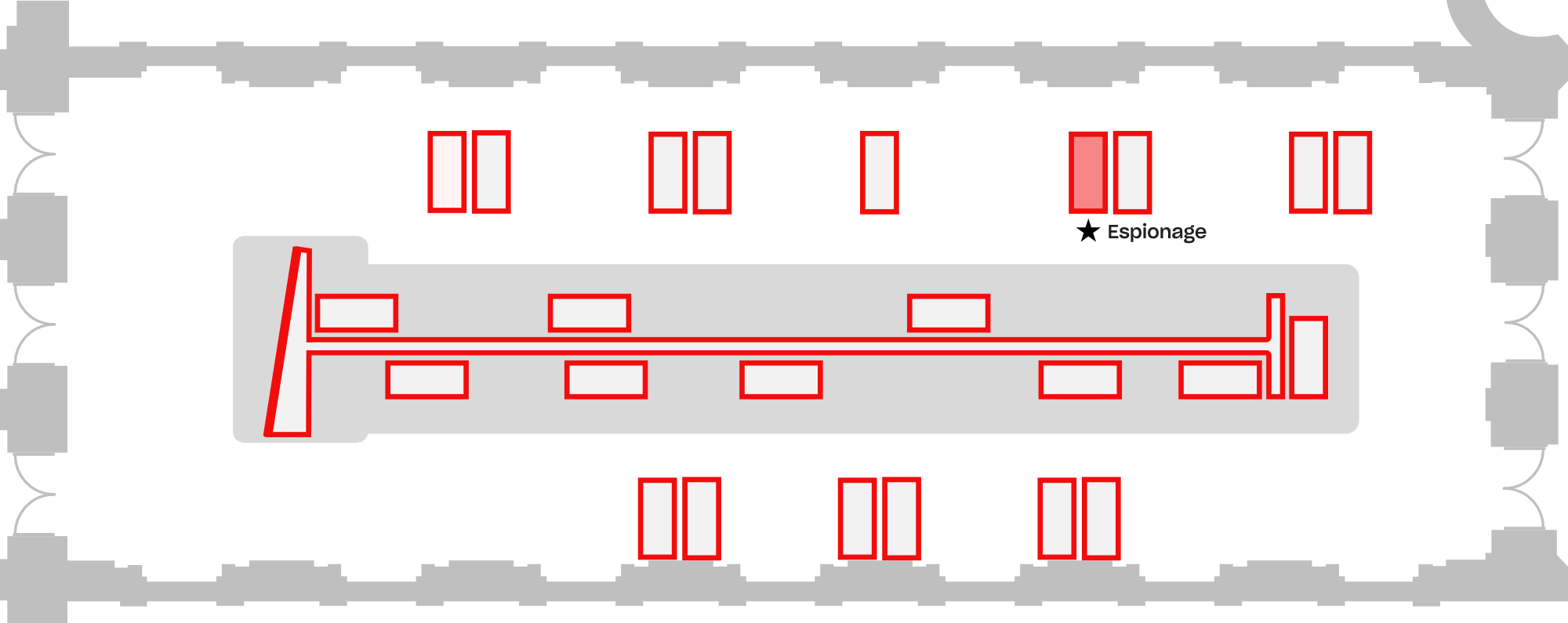
The display case to your left contains five objects:
1. Secret Codes for Washington’s Spies
In 1778, George Washington set up a spy network around New York City, then occupied by the British. “Culper” was the name assumed by Abraham Woodhull (“Samuel Culper”) and Robert Townsend (“Samuel Culper Jr.”). Benjamin Tallmadge (“John Bolton”) ran the spy ring. He devised the numerical codes in this book. The Culper spies used this code to report on the movements of British ships and troops.
Exhibit Item(s)
- Benjamin Tallmadge (a.k.a. “John Bolton”), Culper spy ring code book, 1778–1783. George Washington Papers, Manuscript Division, Library of Congress (066.00.01). A page from a handwritten ledger of numerical codes.
2. Invisible Ink
Members of the Culper spy ring used an invisible ink developed by James Jay, a doctor and chemist. He was a brother of John Jay, later an author of The Federalist Papers and the first chief justice of the U.S. Supreme Court. In this letter, Washington gives his chief spy, Benjamin Tallmadge, instructions for using what he called “white ink.” “C——r Junr,” or Culper Junior, mentioned here, was Robert Townsend, another member of the ring.
Exhibit Item(s)
- George Washington to Benjamin Tallmadge, July 25, 1779 (reproduction). George Washington Papers, Manuscript Division, Library of Congress (067.01.00). A handwritten letter beginning with the words “Sir, All the white ink I now have (or indeed have the prospect of getting soon.)”
3. Aristarchus, the King’s Spy
“Aristarchus” was the name used by a British spy who reported directly to George III. In this letter, he reports on the movements of Benjamin Franklin, who was serving as the U.S. minister to France. Aristarchus writes that Franklin was rumored to be going to the Hague in the Netherlands, but “it is now beyond a Doubt, this veteran Negotiator is going to America.”
Exhibit Item(s)
- Aristarchus to King George III, April 6, 1781 (reproduction). © His Majesty King Charles III 2025 (069.01.00). A handwritten letter beginning with the words “It is a decided point that Dr. Franklin is soon to depart from Paris.”
4. Prince William Henry in New York
In 1781, George III’s son Prince William Henry was serving in the Royal Navy in British-occupied New York. In this letter to his father, he describes the empty pedestal that once held the king’s statue before American crowds tore it down. He also refers to “brave Arnold.” This was Benedict Arnold, the American officer who defected to the British. Arnold tried but failed to deliver the American fort at West Point, New York, to the British.
Exhibit Item(s)
- Prince William Henry, Duke of Clarence, to King George III, New York, September 27, 1781 (reproduction). © His Majesty King Charles III 2025 (070.01.00). A handwritten letter beginning with the words “Sir, Last Monday, about four in the afternoon, we arrived.”
5. A Plan to Capture the Prince
In this letter, Washington approved Col. Matthias Ogden’s plan to capture Prince William Henry and the British admiral who accompanied him. Washington later warned Ogden that the prince would probably be too well guarded to capture, and the plan was never executed. In 1830, the prince succeeded his brother, King George IV, to become King William IV.
Exhibit Item(s)
- George Washington to Matthias Ogden, March 28, 1782, approving a plan to capture Prince William Henry, the Duke of Clarence, in New York (reproduction). George Washington Papers, Manuscript Division, Library of Congress (071.01.00). A handwritten letter beginning with the words “Sir, The spirit of enterprise so conspicuous in your plan.”