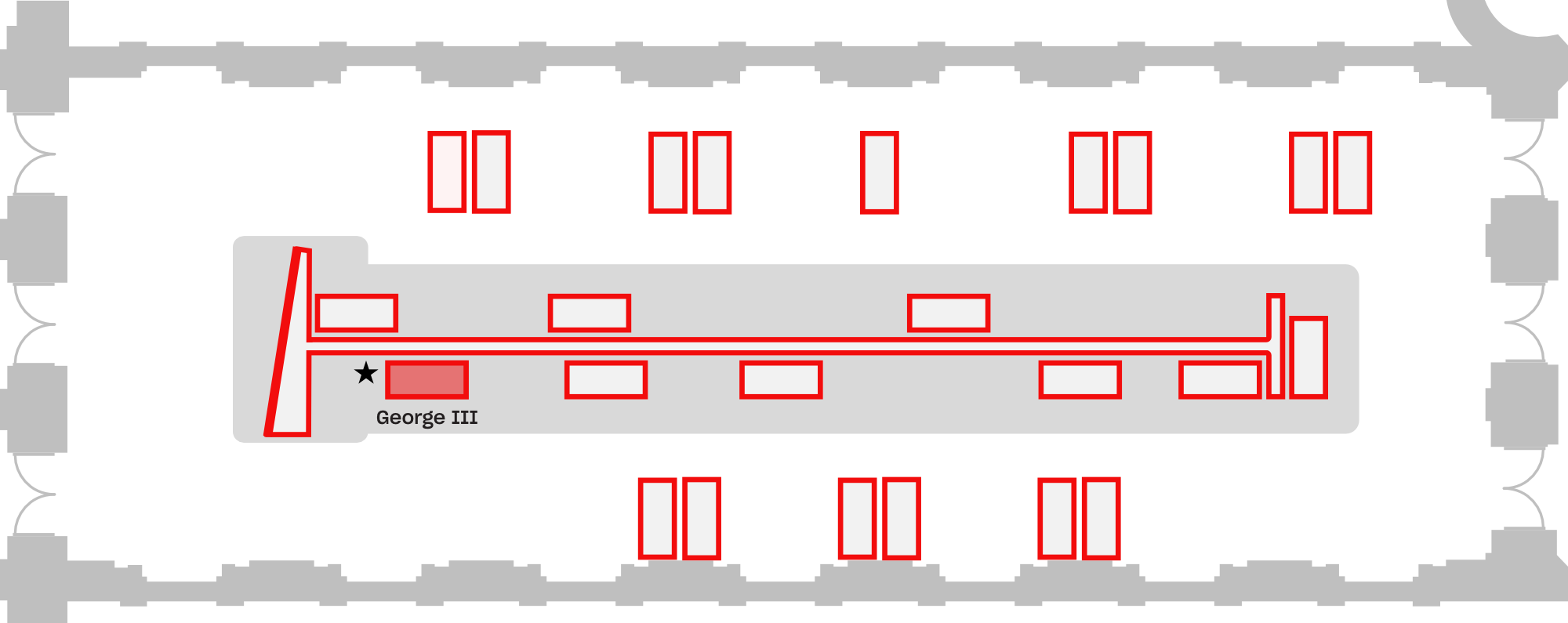

George III
The text panel in front of you reads:
In 1810, George III entered his final illness, from which he never fully emerged. In early 1811, with the king incompetent to reign, the Prince of Wales took over as regent. In the period known as the Regency, George III remained king, but his active rule had come to an end. His death in 1820 was long anticipated and mourning was subdued.
The display case to your right contains three objects:
1. Questionnaire for the King’s Doctors
In 1810, the Prince of Wales submitted a set of seven questions to the king’s doctors. This questionnaire lists the prince’s questions in the right-hand column. The doctors’ answers are on the left. After admitting that the king was incapable of attending to business in his present state, the doctors offered some hope of his eventual recovery. They could not, however, say when that recovery would be.
Exhibit Item(s)
- George, Prince of Wales. Questionnaire to King George III’s physicians on his condition, ca. 1810 (reproduction of pages 2 and 3). © His Majesty King Charles III 2025. A handwritten note discussing “His Majesty’s disorder” including questions in one set of handwriting on the right and answers in another set of handwriting on the left.
To the right of the label is a quote that reads:
“No. 1. Does His Majesty still continue incapable of coming to Parliament or attending to Publick Business?”
“No. 1. His Majesty still continues incapable of coming to Parliament or of attending to Publick Business.”
—George, Prince of Wales. Questionnaire to King George III’s physicians on his condition, ca. 1810
2. A Last Look at George III
Artist Samuel William Reynolds made these mezzotint portraits of George III during the king’s last decade, when he was living in seclusion at Windsor Castle. George III, who had previously sat for many heroic portraits, appears here as he looked at the end of his life: mentally absent and losing his hearing and sight. When the Prince Regent objected to the king’s long hair in the original portrait, Reynolds changed it in response.
Exhibit Item(s)
- Samuel William Reynolds. George III, ca. 1820 (reproduction). © Royal Collection Enterprises Limited 2025 | Royal Collection Trust. A black-and-white drawing of King George III with long hair and a long beard sitting at a table wearing a dark robe.
- Samuel William Reynolds. George III, ca. 1820 (reproduction). © Royal Collection Enterprises Limited 2025 | Royal Collection Trust. A black-and-white drawing of King George III with short hair and a short beard sitting at a table wearing a dark robe.
“Merry Making on the Regent’s Birthday”
There is a framed cartoon on the wall to the right of the display case. This cartoon is also reproduced on the wall behind the display case. The label reads.
The Prince of Wales took over as Prince Regent in 1811 after George III entered his final episode of illness. Satirists reveled in portraying the prince’s recklessness and extravagance, which contrasted with the austerity and restraint of his father. In this cartoon by George Cruikshank, the Prince Regent dances with a married woman, whose cuckolded husband sits sadly behind them. Two devils play the French horn while outside the poor beg for help and two people hang from the gallows.
Exhibit Item(s)
- George Cruikshank. Merry Making on the Regent’s Birthday. Hand-colored etching. J. Johnston, 1812. British Cartoon Prints Collection, Prints and Photographs Division, Library of Congress (103.00.00). A color political cartoon showing the Prince Regent dancing and drinking, with gallows and people living in squalor outside.
George III’s Funeral Procession
There is a large graphic on the wall to the left of the display case. The label reads:
Thousands of mourners came to see George III lying in state at Windsor Castle before his burial at Windsor’s St. George’s Chapel on February 16, 1820. George Cruikshank. Funeral Procession of George III, 1820 (detail). © Museum of London. A color illustration of King George III’s funeral procession showing pallbearers carrying his coffin.