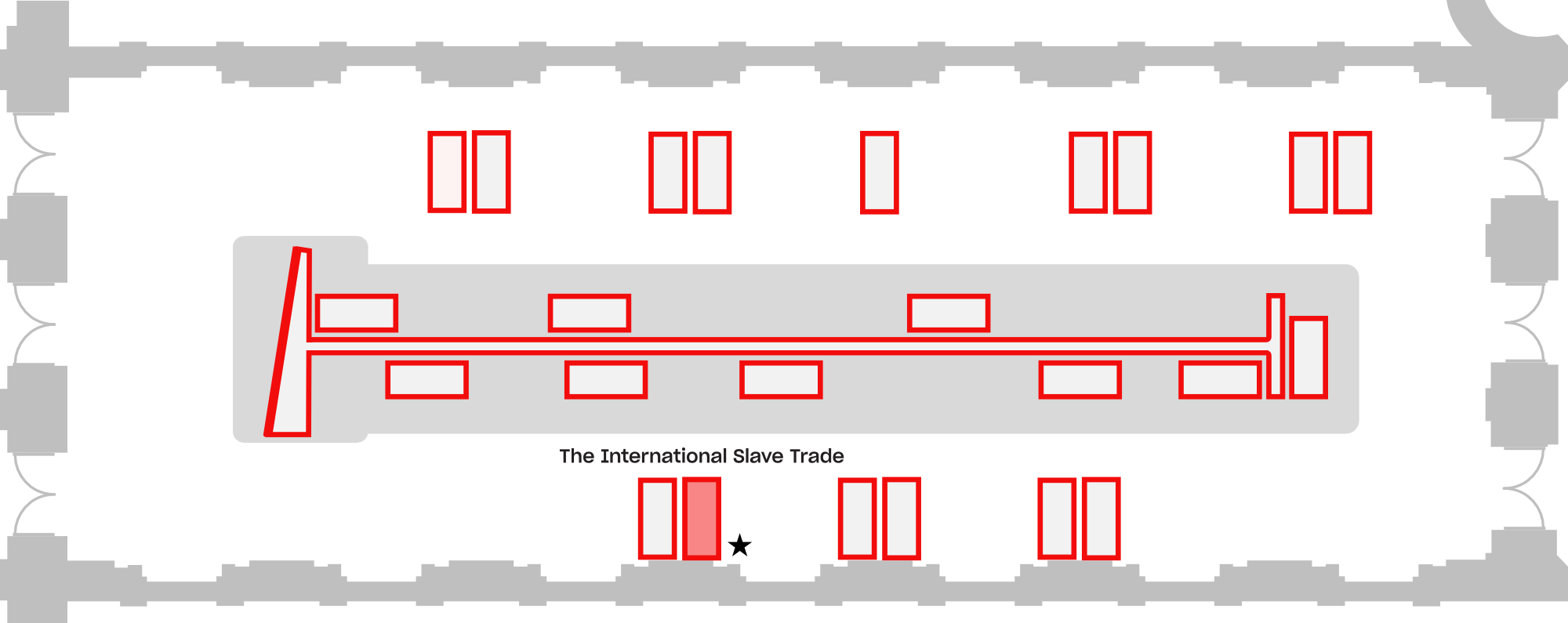

The International Slave Trade
The text panel in front of you reads:
Movements to abolish slavery grew in the United States and Britain during the second half of the eighteenth century. Neither George was convinced by the abolitionist argument and both Georges benefited from the institution of slavery. Despite this, both Georges played a role in ending the international slave trade. Washington helped draft the U.S. Constitution, which set the nation on a path to end its participation in the international slave trade in 1808. And George III signed Britain’s “Act for the Abolition of the Slave Trade” in 1807. Neither country outlawed slavery itself until later in the nineteenth century.
The display case to your right contains three objects:
1. “The Gradual Abolition of the Slave Trade, or Leaving of Sugar by Degrees”
Abolitionists boycotted sugar to signal their sympathy with the enslaved people who grew and processed it in Britain’s Caribbean colonies. In this cartoon, members of the royal family express their willingness to give up sugar even as they consume it. George III and Queen Charlotte are pictured with two of their daughters (left) and the queen’s companion Juliana Schwellenberg (right).
Exhibit Item(s)
- Isaac Cruikshank. The Gradual Abolition off [sic] the Slave Trade or Leaving of Sugar by Degrees, 1792. Hand-colored etching. British Cartoon Prints Collection, Prints and Photographs Division, Library of Congress (101.00.00). A hand-colored political cartoon depicting the royal family discussing their intent to give up sugar as they put sugar in their tea.
2. “An Act for the Abolition of the Slave Trade”
George III gave his royal assent to the abolition of Britain’s transatlantic slave trade in 1807. Slavery itself, however, persisted in the British Empire until 1834. While slaveholders were compensated by the British government for the loss of their human property, people formerly enslaved received no compensation for their years of enforced labor.
Exhibit Item(s)
- “An Act for the Abolition of the Slave Trade,” 25th March, 1807, A Collection of the Public General Statutes. Law Library, Library of Congress (102.00.01). A two-page spread of a printed book beginning with the words “Coast of Countries of Africa, shall be, and the same is hereby utterly abolished, prohibited, and declared to be unlawful.”
3. Olaudah Equiano’s Petition to Queen Charlotte
Olaudah Equiano was an author and abolitionist. In this memoir, he describes his birth in Africa, his capture as a child, and his enslavement in Britain and the Americas before buying his freedom in 1766. In 1788, he wrote Queen Charlotte, “I supplicate your Majesty’s compassion for millions of my African countrymen, who groan under the lash of tyranny in the West Indies.” He included the letter in this book.
Exhibit Item(s)
- Olaudah Equiano. The Interesting Narrative of the Life of Olaudah Equiano . . . Norwich: Printed for the author, 1794. Rare Book and Special Collections Division, Library of Congress (128.00.01). A two-page spread from a printed book beginning with the words “Yet I do not solicit your royal pity for my own distress: my sufferings, although numerous, are in a measure forgotten.”
To the right of the label are two quotes that read:
“I hope it will not be conceived . . . that it is my wish to hold the unhappy people who are the subject of this letter, in slavery. I can only say that there is not a man living who wishes more sincerely than I do, to see a plan adopted for the abolition of it—but there is only one proper and effectual mode by which it can be accomplished, & that is by Legislative authority: and this, as far as my suffrage will go, shall never be wanting.”
— George Washington to Robert Morris, April 12, 1786, Letterbook
“I was visited (having given permisn.) by a Mr. Warner Mifflin, one of the People called Quakers; active in pursuit of the Measures laid before Congress for emancipating the Slaves. . . . He used Arguments to shew [show] the immoralty—injustice and impolicy of keeping these people in a state of Slavery; . . . To these I replied, that as it was a matter which might come before me for official decision I was not inclined to express any sentimts. on the merits of the question before this should happen.”
— George Washington, Diary, March 16, 1790
A large graphic at the back of the display case depicts George Washington’s notes on the draft U.S. Constitution. The caption reads: Article 1, Section 9 of the U.S. Constitution permitted the transatlantic slave trade to continue for another twenty years, with an end date of 1808. This was one of the many compromises between delegates at the Constitutional Convention who represented slave and free states. This draft belonged to George Washington. He marked it up during the Convention. Report, Committee of Style and Arrangement, Constitutional Convention, Philadelphia, September 12, 1787, Annotated by George Washington, p. 2. George Washington Papers, Manuscript Division, Library of Congress