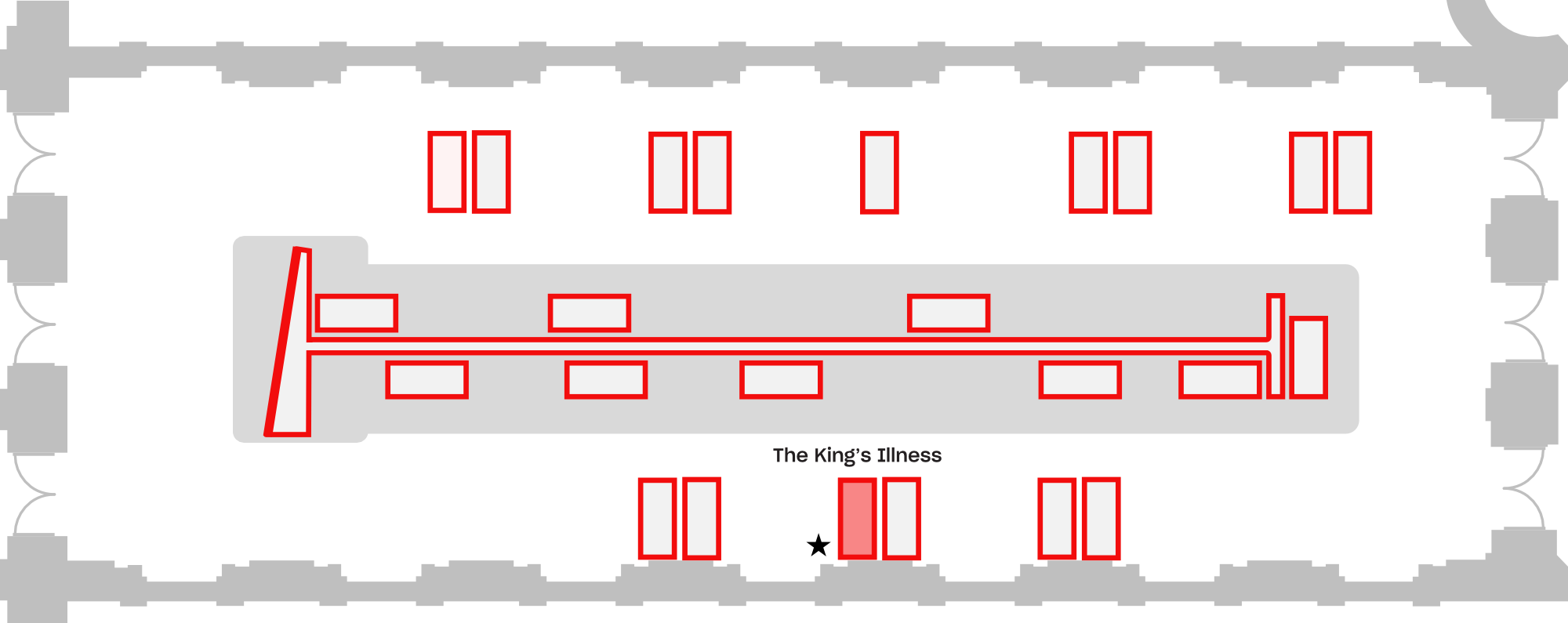

The King's Illness
The text panel in front of you reads:
Popular representations of George III have perpetuated the idea of the “mad king.” George III experienced episodes of delusion, rapid speech, violent behavior, stomach upsets, and other symptoms on several occasions. Only two were serious and prolonged. One of these lasted from the fall of 1788 to early 1789. The other began in 1810 and continued until his death in 1820.
There are multiple theories about what, exactly, the king’s illness was. One idea is that he had the disease porphyria. Another theory is that he suffered from bipolar disorder. While his diagnosis remains uncertain, first-hand observations of his symptoms and behavior are preserved in the records of his doctors and in the diaries of courtiers.
The display case to your left contains four objects:
1. “The strait waistcoat”
Robert Fulke Greville was an equerry (a personal attendant) to George III. From the fall of 1788 to the spring of 1789, he recorded in his diary the king’s first prolonged bout of madness. On December 15, 1788, he recorded the first time the king’s doctors restrained him: “During the night recourse was had for the first time to the strait waistcoat.”
Exhibit Item(s)
- Robert Fulke Greville. “Journal of His Majesty’s Most Serious and Afflicting Illness.” Volume two, October 1788–March 1789 (reproduction). © Royal Collection Enterprises Limited 2025 | Royal Collection Trust (089.01.00). A handwritten page beginning with the words “should have reached his knowledge which had required a caution so well intended, from so steady a Friend.”
2. “He conceived himself to be no less a Personage than George Washington”
In 1789, Washington’s friend Gouverneur Morris wrote to him from Paris. He mentioned a surprising aspect of King George’s madness: “In the melancholy Situation to which the poor King of England has been reduced. . . . in one of his Capricios, [he] conceived himself to be no less a Personage than George Washington at the Head of the american Army. This shews [shows] that you have done Something or other which sticks most terribly in his Stomach.”
Exhibit Item(s)
- Gouverneur Morris to George Washington, February 23, 1789 (reproduction). George Washington Papers, Manuscript Division, Library of Congress (090.01.00). A two-page spread from a handwritten letter beginning with the words “Exchange and am in Consequence in your Debt.”
3. “My tedious illness”
Upon his recovery, George III wrote his prime minister: “I feel the warmest gratitude for the Support and Anxiety shewn [shown] by the Nation at large during my tedious illness.”
Exhibit Item(s)
- George III to William Pitt, February 23, 1789 (reproduction). © His Majesty King Charles III 2025 (091.01.00). A handwritten letter beginning with the words “It is with infinite Satisfaction I renew my correspondence with Mr. Pitt.”
A graphic at the back of the case shows a saucer displaying the words “Huzza The King is well.” The image caption reads:
Saucer commemorating King George III’s recovery, 1789 (detail). © Royal Collection Enterprises Limited 2025 | Royal Collection Trust