



The extraordinary career of cartoonist Herbert Block (Herblock) spans seven decades. Although Mr. Block has been a presence on the American scene with his daily editorial cartoons for the better part of the 20th century, exhibitions of his original drawings are exceedingly rare.
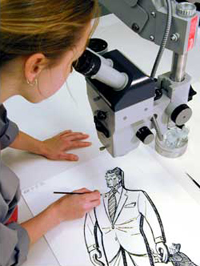
Kaare Chaffee, a conservator for the Library, consolidates layers of media to stabilize drawings for the Herblock exhibition. - Marita Clance
To prepare more than 100 drawings for the exhibition, professionals in the Library's Conservation Division were called upon to examine and treat the drawings, all of which came directly to the Library from the artist himself. What was revealed from this intensive effort about Mr. Block's technique is interesting. In addition to being stylistically consistent throughout his career, Mr. Block's drawing technique and choice of materials have also remained fairly constant. In the selection of drawings received by the Library, the drawings are nearly always executed on a commercially available paper with a 3-D pattern imposed on its surface. This pattern, commonly called coquille, is designed to catch dry, powdery media such as that used by Mr. Block.
The artist's choice of drawing media has also remained fairly consistent. Mr. Block generally begins a drawing with a faint pencil sketch on which he builds a final image. Graphite media (pencil) is the most abundant material used, with details for figure outlines strengthened with a black ink (presumably india ink) applied with a brush, pen or both. The graphite is applied very loosely and defines shapes and adds shading. In only one drawing does Mr. Block employ the transparent shading film Zip-a-Tone used by so many other cartoonists to save time on the tedious task of shading. Opaque white correction fluid is used not only to cover errors but also as another media to define details. A complicated system of applying several layers of media on top of one another to create a special effect is employed on some of the drawings.
The challenges presented in conserving the drawings were related to their construction not their past use. Because they had been in the sole possession of the artist since their creation, the usual kinds of damage associated with poor framing, handling and exhibition practices were not present. Of main concern were issues surrounding the still fresh and extremely friable graphite and the complicated build-up of media layers. For example, on a number of drawings, the white correction fluid was cracking and falling off the paper. Treatment to resolve this problem involved a close inspection of the entire surface of a drawing under magnification and consolidation of areas that were in danger of falling off. Consolidation involves flowing an appropriate adhesive into the cracked areas and lightly pressing to ensure contact. This is an exacting procedure that must be done with great skill and patience.
A critical part of the drawings' preservation lies in reducing the risk of future damage. Because the graphite media is so easily smudged, the drawings will be treated in the same way as fragile pastel drawings. They will be hinged into archival quality mats so that their surfaces are protected from direct contact. Once in their proper conservation housing, they should remain as "untouched" as they were when they left Mr. Block's studio.


