



"Today more organizations are promoting reading than at any other time in our country's history," said Center for the Book Director John Y. Cole on March 22 in welcoming participants to the center's annual "idea exchange" for its national reading promotion partners.
"Yet as a nation we continue to experience serious reading and literacy problems. Moreover, many observers worry that those who do not or cannot read in this technological age are rapidly falling behind the rest of society. Our job is to reach as far as we can into all walks of life in demonstrating the essential and practical value of reading to individuals of all ages. And the Internet gives reading promoters new opportunities."

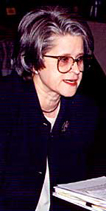
Left, Mary Brigid Barrett, founder and president of the National Children's Book and Literacy Alliance, with Center for the Book Director John Cole; right, Carol Rasco. - Lorenzo Wright
More than 30 educational and civic organizations sent representatives to the meeting in the Library's Mumford Room, which was decorated with reading promotion posters and filled with descriptive literature about current and future promotion projects sponsored by the center's network of reading promotion partners. (For a full list of partners, visit the Center for the Book's site on the World Wide Web at: aj.sunback.homes/loc/cfbook).
Mr. Cole described the center's reading promotion network and partnership program, which was established in 1987 with the center's national "Year of the Reader" campaign (see LC Information Bulletin, March 1998). The network's annual meeting at the Library of Congress brings the partners together to describe their organization's activities and learn about reading and literacy programs in which they can become involved. A brochure distributed at the meeting outlined ways that partners and other organizations could use the center's current promotion theme, "Building a Nation of Readers." Center for the Book Program Specialist Anne Boni, who represents the center at many meetings organized by partner organizations, pointed out how mutual support of each other's projects and themes widened the audience for all projects and themes.
Center for the Book Program Officer Maurvene Williams discussed the growing importance of the center's Web site in providing information about organizations and their reading and literacy projects. In February 1998, for example, the site handled 15,000 transactions; in February 1999, 21,000. She announced a new "Building a Nation of Readers" feature that also will mark the Library of Congress's Bicentennial in the year 2000. Partner organizations as well as individual libraries, schools and government agencies are invited to describe one reading promotion project (in 50 words or less) for posting on the Center for the Book's Web site. The goal is to have 200 projects posted by April 24, 2000 -- the Library's 200th birthday.
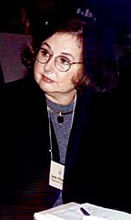

Left, Sandra Maccarone of the Weekly Reader Corp., cosponsor of the "Letters About Literature" project; right, the Center for the Book's Anne Boni and Cindy Towsner of the U.S. Department of Education discuss a family literacy publication. - Lorenzo Wright
Following the first presentation, by Carol Rasco, director of the U.S. Department of Education's "America Reads Challenge", each reading promotion partner made a brief presentation about his or her organization and its activities. Moderator John Cole introduced several new partners, including the Academy of American Poets, the Antiquarian Booksellers Association of America, the Children's Creative Writing Campaign, the National Center for Learning Disabilities, the National Children's Book and Literacy Alliance, the National Endowment for the Arts, First Book and the National Geographic Society.
Center for the Book Consultant Virginia Mathews, who directs the Center for the Book/Viburnum Foundation Family Literacy Project, concluded the day's presentations. She summarized six important "current trends" or "hot topics" in reading promotion projects for young people. Ms. Mathews believes that these trends, if acted upon, could lead to new collaborative projects for their respective organizations. They are: family literacy projects; out-of-school reading and literacy programs; mentoring, particularly community-based mentoring programs; projects that include parental involvement; "very" early childhood projects, e.g. "Born to Read"; and cooperative projects with health organizations.


