



Patch Adams, M.D., about whom a major motion picture starring Robin Williams was made, led a group of 25 Washingtonians in reading their favorite poems aloud April 7 in the Coolidge Auditorium.
Mr. Adams is author of Gesundheit!: Bringing Good Health to You, the Medical System and Society Through Physician Service, Complementary Therapies, Humor and Joy. He advocates universal free health care. He gave a dramatic recitation of portions of Walt Whitman's "Song of the Open Road," saying he loves the poem "because poetry is a celebration of life. This poem reflects me. I celebrate life."
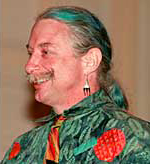


Patch Adams, M.D.; Marvin Dickinson, vice president of the Stay in Schools Foundation; Del. Eleanor Holmes Norton (D-D.C.) - N. Alicia Byers
Mr. Adams wore his long gray hair in a ponytail with several elastics along its length. A patch on his head to the left of his center part was dyed blue. He wore a Hawaiian shirt with a multicolored tie, tie-died balloon pants, one orange and one blue sock and black tennis shoes. One fork-shaped earring dangled and swung as he recited Walt Whitman's conclusion: "the efflux of the soul is happiness."
If Mr. Adams's outfit was like a rainbow, the other persons who read were a veritable United Nations of Washington: African American, Peruvian, Italian, a Native American, Chinese, Russian. Their cacophony of accents was unified by the rhythm of the poetry that now harangued, now lulled about 250 listeners into a state of heightened awareness.
Mr. Pinsky said one of the unexpected fruits of the Favorite Poem readings is the way the audience forms a community of listeners as the readers and reciters share why the poem is meaningful to them.
Said Mr. Pinsky: "You get this feeling of respect and attention in these civic forums," of which there have been 15 official -- and almost 300 unofficial -- readings, and probably many more that go unreported to the Favorite Poem Project director at Mr. Pinsky's Boston University office.
"These transcendently wonderful moments come along and you sense the audience cheering up," Mr. Pinsky told a handful of reporters before the reading, which came just as the Library announced his unprecedented reappointment to a third consecutive term as Poet Laureate. "Each person is showing you a treasure," Mr. Pinsky said later in remarks prior to the Coolidge Auditorium readings.
Dr. Billington said he liked the poem "Little Gidding" by T.S. Eliot because it "brings a spiritual dimension into our daily lives." He told how Eliot wrote the poem in 1942 as bombs fell on London and explained several interpretations of its elusive text. He confided that he personally interprets the "tongues of fire" in the poem as "the slow fire that consumes us: our own self-preoccupations."
Philip Bobbitt, the creator of the Library's Rebekah Johnson Bobbitt National Prize for Poetry, read "Preparation," by Czeslaw Milosz, whose poetry both Robert Pinsky and 1996-1997 Poet Laureate Robert Hass helped to translate from Polish. "Our prayers are with the 600,000 refugees from the Yugoslav war and the soldiers who have gone to Eastern Europe," said Mr. Bobbitt, who is Lyndon Johnson's nephew. His cousin, Linda Johnson Robb, was in the audience. Milosz's poem recalls earlier strife in Eastern Europe: "Thus: armies/Running across frozen plains, shouting a curse/ In a many-voiced chorus; the cannon of a tank/ Growing immense at the corner of a street; the ride at dusk/ Into a camp with watchtowers and barbed wire."
Others who read included Del. Eleanor Holmes Norton (D-D.C.), (Sonnet 127, by William Shakespeare); Roslyn Walker, director of the National Museum of African Art, ("The Negro Speaks of Rivers," by Langston Hughes); Nobel Laureate Harold Varmus, director of the National Institutes of Health ("To His Coy Mistress," by Andrew Marvell); Cliff Becker, director of the Literature Program at the National Endowment for the Arts ("Keeping Things Whole," by Mark Strand). "We try to do that at the NEA," he said.
"Some poets write with such power and immediacy that they can convince you the poem is about your own life, but it's not," said the final reader, Edward Weismiller, who was billed as 'novelist, counterspy and poet," in the program. He read John Donne's "Twickenham Garden" because "it involves me in a way I can't explain." When he recited it, the audience may have understood with him what it is in a poem that words can't -- but somehow do -- convey.


