



On the morning of April 26, the air in the Coolidge Auditorium was filled with the excitement of more than 200 fourth and fifth grade students. They came from Bolling Air Force Base, Brent Museum Magnet School, Capitol Hill Day School, Stuart Hobson Elementary School, Walker Jones Elementary School and Watkins Elementary School for, what Public Service Collections Director Diane Kresh called, "a different kind of history lesson."

Different it was, as the students' enthusiasm for learning transformed the program into an intellectual journey.
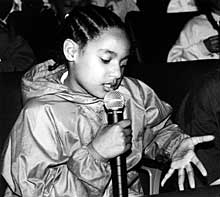
During a question-and-answer period before the program, the children peppered Ms. Kresh, who moderated the program, John Cole, director of the Center for the Book, and Marvin Kranz, American history specialist in the Manuscript Division, with inquiries about the Library. The students' interest varied from the number of visitors the Library receives annually to the number of books it houses, the size of the staff and the type of work they do.
Ms. Kresh welcomed the students, teachers and librarians, and introduced the Library specialists and curators who would introduce and present the selected readings, which focused on childhood experiences. The readings were accompanied by slides of historical photographs selected by Beverly Brannan, curator of photography in the Prints and Photographs Division.
Norman Middleton, concert producer for the Music Division, read excerpts from Narrative of the Life of Frederick Douglass (1849), in which the former slave, statesman and foremost African American spokesperson of the 19th century described how he learned to read. Mr. Middleton also read an 1859 letter from 10-year-old Annie Douglass to her father, Frederick, who had fled to England in the wake of John Brown's raid. Annie would die less than a year later, and Douglass would return to the United States to mourn her passing. Background information for these readings was provided by Adrienne Cannon, African American history and culture specialist in the Manuscript Division.
Marvin Kranz introduced Francis "Frank" French, who lived on East Capitol Street near the site of the Library's Jefferson Building during the mid-1800s. Lynn Schrichte, an accomplished local actress, read excerpts from French's 1850 journal, written when he was 12. French provided a "boy's-eye-view" of political events in mid-19th century Washington, including the deaths of former president Zachary Taylor and Sen. John C. Calhoun, and Henry Clay's famous speech in which he outlined the Compromise of 1850. French also wrote of visiting the Patent Office, the Smithsonian Institution and the Library of Congress, and of the Fourth of July celebration at the Washington Monument.
Mary Wolfskill, head of the Reference and Reader Section in the Manuscript Division and a specialist on anthropologist Margaret Mead, introduced the audience to Mead and her studies of the nonliterate peoples of Oceania. Mead kept diaries throughout her life that were included in the 500,000 items that she donated to the Library upon her death in 1978. Ms. Schrichte read an excerpt from Mead's first diary, which she began in 1911 at the age of 9.
Mr. Kranz then introduced young Billy Gobitas, who wrote a polite but stubborn letter to the Minersville, Pa., school directors in 1935 explaining why he, as a Jehovah's Witness, could not salute the United States flag. Ms. Schrichte read Gobitas's letter, which ignited a lawsuit that went all the way to the Supreme Court. The Supreme Court ruled against Gobitas in 1940, but reversed itself in 1943.

The final two readings centered on the "Little Rock Nine," whose integration of Central High School in Little Rock, Ark., required President Eisenhower to send in federal troops. The first selection, introduced by Ms. Cannon and read by Mr. Middleton, was a 1957 letter from Daisy Bates, head of the Arkansas chapter of the National Association for the Advancement of Colored People (NAACP) and a key figure in the integration of Central High, to Roy Wilkins, executive director of the NAACP, about the treatment of the nine black students.
Mr. Middleton (above, with Adrienne Cannon) then read from a moving 1959 NAACP document, "The Ordeal of Minnie Jean Brown: One of the First Nine Negro Students to Attend Central High School in Little Rock, Arkansas." Brown was expelled from Central High for retaliating against a litany of mistreatment from her classmates.
At the conclusion of this reading Mr. Middleton shared his personal experiences as one of nine students who integrated the all-white Walker Junior High School in Bradenton, Fla., in 1965.
The participants fielded the questions that followed.

"Mr. Middleton, did you get a better education by attending the white school?" a student asked.
"No. The facilities were better, and the books and materials were better, and they had a lot of resources and programs that the black school didn't have. But the teachers were no better, and they clearly did not want to teach me. They would ignore my raised hand and my questions. And I felt that they did not grade me fairly. I always had wonderful teachers in the black schools -- who lived in my neighborhood, belonged to my church and truly cared about my education. No, my education was not better at the white school.
"Of all of the anthropologists in the world, why did Margaret Mead become famous?" asked another.
"Because of her personality and her outspokenness, and because that was her intention," said Ms. Wolfskill. "Unlike many in her field, she did not write just for scientific journals. Mead wrote for the general public. The first of her 23 books, Coming of Age in Samoa (1923), is still read by students."
"How long was the school year in 1850?"

Said Mr. Kranz: "According to French's journal, it was 11 months long. August was the only month of summer vacation."
It was past time for the children to return to school. But the "different kind of history lesson" was not yet over. Ms. Kresh urged the students to e-mail further questions to the "Building a Nation of Readers" Web address (aj.sunback.homes/loc/kidslc) and to check out the "Read More About It!" bibliography included in the program packets.


