



Following is Part 1 of two articles that will cover events from the Library's first Bicentennial symposium. Part 1 reports on the first day of the conference, June 15; part 2 will report next month on the June 16 and June 17 proceedings. The symposium was made possible through the generosity of the American Academy of Achievement and the Heinz Foundation.

The turn of a century inevitably conjures thoughts of the past and the future.
The turn of the 20th century was no exception. In 1904, in St. Louis, the Congress of Arts and Letters, as part of the Universal Exposition, held a conference on the achievements of the 19th century and what might be in store for the next.
This meeting of the minds was the inspiration for a June 15-17 symposium at the Library, "Frontiers of the Mind in the 21st Century," in which some 50 scholars representing 24 fields of knowledge discussed the most important accomplishments in the current century while making some predictions for the 21st.
This first symposium, part of a series of symposia and other events celebrating the bicentennial of the Library of Congress, was open to anyone with sufficient intellectual curiosity either to walk to the Jefferson Building's Coolidge Auditorium or listen to a "cybercast" on the Library's Web site at www.connectlive.com/events/libraryofcongress (the proceedings are available online through the end of 1999 and the final texts will be available in print and online at a later date).
According to Dr. Billington, the symposium, was "an echo, in a slightly different form, of a conference that Congress had asked the Library of Congress to organize as an assessment of where knowledge had been in the 19th century and what the frontiers of knowledge might be in the 20th.
"It is thus appropriate that this symposium opens our series of events celebrating the Library as the oldest federal cultural institution," whose 200th birthday is April 24, 2000.
Daniel J. Boorstin, Librarian of Congress Emeritus, next spoke about "the inspired theme of this conference: the convergence of the past and the future, which is the theme of any great library and which reveals a magic ambivalence in the monuments of the past and the beacons of the future."
Prosser Gifford, the Library's director of scholarly programs, explained how the conference would proceed and admitted that many people would have favorite topics that were not included because not all areas of knowledge could possibly be explored in three days, but he hoped that "we will concentrate on those we have included." He noted that the sessions of the symposium were organized so that "disciplines that have something to say to each other" could do so.
Rep. Vernon J. Ehlers (R-Mich.), who serves on the joint committee on the Library of Congress and has been a strong supporter of the institution's electronic initiatives, remarked on the "danger" in making predictions. "As [the physicist] Neils Bohr said, 'It is very difficult to make predictions, especially about the future,'" for they are often wrong. Yet, "the entire world will benefit from the ideas presented here."

A group of the "many famous lecturers" at the International Congress of Arts and Sciences in 1904.
Dr. Billington then introduced the chair of the June 15 morning session, Bruce Alberts, president of the National Academy of Sciences. Mr. Alberts remarked on the "impossible" nature of the task: trying to summarize in 15 minutes -- the time the principal presenters were given to make their points -- all of the most important achievements of many disciplines in the past century while looking to possible achievements in the future. He was willing to predict, however, that "the discoveries, as remarkable as they have been in this century, will be even more so in the next."
Given the task of summarizing developments in cosmology was Martin J. Rees of Cambridge University in England and Astronomer Royal of Great Britain. Mr. Rees discussed astronomy as an evolutionary science, akin to the theories of Darwin, but he spoke primarily about the discovery of "black holes" and the origins of the universe itself as being among the century's most important scientific advances.
"There are three great frontiers in science," he said. "The very big, the very small and the very complex. Cosmology involves them all. ... Its aim is to understand how a simple fireball evolved over 10 to 15 billion years into the complex cosmic habitat we find around us. How on at least one planet around one star creatures evolved able to wonder about it all."
Marc Davis from the University of California at Berkeley explained, as commentator, the technical ways in which we had gained the startling insights into the nature of very distant, and hence very early, light in the universe. His remarks demonstrated, as became apparent again and again in the conference, the cooperative competition between theory and observation in astronomy, or theory and experiment in many other sciences.
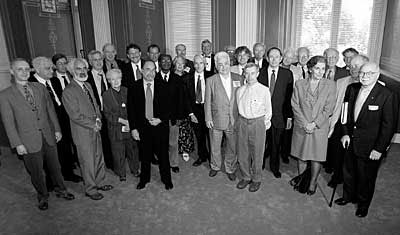
The speakers at the "Frontiers of the Mind" symposium included (front row), Pierre Manent, Michael Fishbane, Mary Douglas, David Baltimore, Kwabena Nketia, Judith Brown, Martin Rees, Mohammed Arkoun, Michael Monastyrsky, Laura Nader and Daniel Bell; (back row) Vyacheslav Ivanov, Michael Woodford, Bruce Alberts, Jerome Friedman, Eric Lander, Marc Davis, Jonathan Spence, Prosser Gifford, Bert Bolin, Steven Pinker, Nils Hasselmo, Gerald Edelman, Leon Lederman, Neil Smelser, Shlomo Aviner, Wallace Broecker and Charles Rosen. - Pat Fisher
Physicist Leon M. Lederman of the Illinois Institute of Technology focused on the "very small." He described "six major revolutions" of physics going back not just to the beginning of the current century but to the late 17th:
- Isaac Newton's 1687 Principia Mathematica, whose "impact rivals any single body of work in the history of mankind. From it flowed a succession of profound changes in human thought and capabilities. ... His deepest impact was the recognition of how orderly the world was and that this order could be understood and used."
- Electromagnetic theory, in which the nature and behavior of things electrical "were unified into one comprehensive theory. That so huge a variety of phenomena could be described by a few beautiful equations," set forth in the 19th century, "furthered the idea that the world was indeed knowable."
- The "conquest of the atom," between 1910 and 1930 gave rise to quantum mechanics, which "gave us a unified and comprehensive command of the atomic world. ... and it was profitable," he said, referring to how this discovery made it possible for the computer revolution.
- "At about the same time, Einstein and others were giving us a new view of the cosmos and a new and unified view of the nature of time and space. ... The mind could now reach to the edges of the universe."
- In the 1930s "came the assault on the nucleus, occupying only a millionth of a billionth of the volume of the atom. ... Radioactivity was understood for its power and peril."
- The 1960s "witnessed the beginnings of a new organization of the stuff from which everything is made." Then the so-called Standard Model of the 1980s provided "a concise summary of everything [in physics] that has been discovered since the discovery of the electron in 1897.
Mr. Lederman concluded that "all six revolutions began as abstract studies whose implications for society were concealed in distant futures. In each new phase, a new piece of reality was revealed."


Left, Marc Davis; right, Leon M. Lederman. - Fermilab
Jerome Friedman of the Massachusetts Institute of Technology again emphasized in his comments the complex relationships in physics between theories, the most advanced of which are not subject to experimental verification, and experiments, which sometimes result in observations requiring reconceptualization of theory.
Phillip Griffiths, a mathematician who heads the Institute of Advanced Study at Princeton University, began by backing up Mr. Gifford's emphasis on the importance of various fields of knowledge being able to "talk to each other."
"One of the great discoveries of the 20th century," said Mr. Griffiths, has been that different kinds of scientific knowledge, including mathematics, are strongly interrelated. This network of knowledge can be seen as a vast set of principles and relationships that extends from invisible atomic particles to the vast biological and social systems of the earth."

From left: Phillip Griffiths, Michael Monastyrsky, Jonathan D. Spence, Judith Brown, and Emmanuel Le Roy Ladurie. - Randall Hagadorn and Michael Marsland
Mr. Griffiths, like Mr. Alberts of the National Academy of Sciences, also spoke to the "impossibility" of his job: "The 20th century has been a fertile time for the resolution of longstanding problems such as Fermat's Last Theorem and for a wealth of accomplishments that would require at least an encyclopedia to describe."
As commentator, Michael Monastyrsky of the Institute of Theoretical and Experimental Physics in Moscow spoke insightfully about the mistaken predictions of great mathematicians of the past. He too emphasized that progress in mathematics is made by solving difficult concrete problems leading to the creation of deep generalized structures. He spoke of topology as the science of the 20th century and related its development to the interruptions of mathematical continuity occasioned by the two world wars of 1914-18 and 1939-45.
Mr. Monastyrsky concluded the morning session. That afternoon, Nils Hasselmo, president of the Association of American Universities, thanked the Library for providing him the opportunity to "wrestle with these enormously important questions."
Jonathan D. Spence of Yale University, whose topic was "History and Politics," told how "once-accepted views" of the relationship between science and history laid out in 1904 "have all proved to be erroneous or harmful."

Bookplate from the proceedings of the turn-of-the-century conference that inspired "Frontiers."
"Those views as originally formulated are now seen as having reflected little more than the self-congratulatory stance of a white male Protestant elite, raised in a highly restricted cultural and social setting. ...
"Science does not reveal a cumulative rise of wisdom and certainty, but rather revealed itself as the contriver of unparalleled forces of destruction that affect every individual. ... The continuous march along a path of progress was patently untrue, as one observed entire populations sliding back into poverty and degradation, while others exploited their raw power in even crasser ways," Mr. Spence observed.
Judith Brown of Oxford University commented principally on two of the themes that Jonathan Spence had mentioned concerning 20th century history -- the increasing integration into political history of non-Western civilizations, such as those of China and India, and the growing presence and voice of women throughout history and as historians.
Emmanuel Le Roy Ladurie of the Collège de France was unable to attend the conference. The argument of his paper on the "renewal of the historian's craft during the 20th century" was presented by Thomas Hughes (right) of the University of Pennsylvania.
The French historian Marc Bloch "was one of those great historians who diverted the attention of our colleagues from the consideration of short-term events to structures [of] long duration and the flow of profound development."
In his comments, Mr. Hughes emphasized that Bloch, although best known for his work on early modern Europe, also attended to the 20th century. Mr. Hughes pointed to the history of the man-made environment and the history of technology as two additional aspects of social history in this century that required emphasis.
Contrary to the sentiments of many of the other presenters who lamented the fact that there was not enough time to cover their subjects in so short a space, Pierre Manent of the École des Hautes Études en Sciences Sociales in Paris said he was confronted "with an unexpected difficulty: not an overflowing wealth of materials, but, on the contrary, a singular dearth of them."
"Our century has witnessed the disappearance ... of political philosophy. ... certainly no Hegel, no Marx, even no Comte has lived in our century, able to convey to the few and the many alike the powerful vision of our social and political statics and dynamics."
Mr. Manent continued that totalitarianism, the "experimentum crucis" of political philosophy of the 20th century, "radically tested" this philosophy, and it failed. "The mere fact that such terrible enterprises could arise was proof that no rational and humane understanding of modern political circumstances had developed and taken root in Europe. ...
"Political philosophy was not nearly able to give a satisfactory account of totalitarianism during and even after the fact. This time the owl of Minerva could not take its flight," said Mr. Manent. His paper concluded with a trenchant analysis of the necessity for continually reconstructing democracy.
Shlomo Avineri of Hebrew University developed the differences between totalitarianisms: the failed ideology of Marx articulated goals of social equality it could never reach, whereas the achieved aims of Nazism had no such ideals. Murderous barbarities affecting millions of people were committed in the name of both, but they should not for that reason be thought synonymous.
The final three speakers of the day discussed genetics, neurobiology and psychology, which, according to session chair Rita R. Colwell, director of the National Science Foundation, have experienced an "unprecedented convergence" in their recent findings.
Eric S. Lander of the Massachusetts Institute of Technology said that fulfilling one goal of the symposium, assessing the achievements of the 20th century -- in genetics in this case -- would be "simple," given the fact that "all scientific knowledge about genetics is a product of the 20th century." He explained that although Gregor Mendel "planted the seeds of genetics" in 1865, his discoveries lay dormant until the beginning of the current century.
In regard to the symposium's other goal, forecasting advances, that would be "foolhardy," said Mr. Lander. Instead, he chose to describe the agenda for genetics in the 21st century "as it appears from the vantage point of 1999."

From the 1904 Congress of Arts and Letters: Edward Bourne of Yale University, Charles Colby of McGill University, Rep. James Perkins and John Bury of Cambridge University.
Completing "biology's periodic table" -- mapping the roughly 6,000 genes, is a job that still requires much work. But once that goal is achieved, it will "become routine to characterize species by sequencing their complete genomes." Not only will this ability provide vast potential for understanding disease, but it will also have the potential to explain evolutionary history -- of great interest to anthropologists. Genetic variants can be used to track population migrations.
David Baltimore, president of the California Institute of Technology (right, photo by Bob Paz), commented upon both the therapeutic hopes and the ethical dilemmas inherent in a more complete knowledge of the human genome. It is difficult to predict and difficult to be wholly sanguine about the uses to which scientific knowledge may be put in the coming century.
In the field of neurobiology, according to Gerald D. Fischbach of the National Institutes of Health (left), it will be important to discover how proteins, genes and neurons work together. For example, "It is naive to think that one neural circuit and only one can accomplish a particular task. ... Once we know how things work alone, we must determine how they work together."
Mr. Fischbach predicted that "as this level of analysis advances, distinctions between neurological sciences and psychiatry will disappear, as they will be seen as different ways of describing the same phenomena."
Gerald Edelman of the Scripps Research Institute (right) focused on what he regards as the greatest challenge of neuroscience: "understanding the neural basis of consciousness." He views this as a biological challenge equivalent to that faced by physics at the beginning of the century. "With consciousness, subjectivity is the subject," he said.
Day 1 concluded with remarks by Paula Tallal of Rutgers University (left, photo by Dennis Connors) and Steven Pinker of the Massachusetts Institute of Technology (below right, photo by Donna Coveney). Mr. Pinker's principal prediction is that psychology "will be instrumental in completing the unification of human knowledge, the phenomenon dubbed 'consilience.' ... This will happen in three new disciplines at the intersection of psychology and biology":
Cognitive neuroscience will study the relation of cognitive and emotional processes to the activities of the brain.

From left: David Baltimore, Gerald D. Fischbach, Gerald Edelman, Paula Tallal, and Steven Pinker. - Bob Paz, Dennis Connors, and Donna Coveney
Evolutionary psychology will seek to relate adaptive pressures to mental and ultimately neural processes of cognition and emotion, "and therefore can sometimes identify common psychological ... emotions and thought patterns across cultures even when behavior differs.
Social psychology, which will study how the nature of a relationship can be used to predict interreactions.
Mr. Pinker said it would be "foolish" to predict that "this blessed unification will happen any time soon," but when it does, a scientific understanding of human nature may be achieved.
Ms. Colwell brought the day's activities to a close by quoting a person whom "some consider the greatest philosopher of all time: Yogi Berra.
"It's very hard to make predictions, especially about the future."
Perhaps, to borrow Mr. Gifford's words, even sports and science "have something to say to each other."


