



In his remarks on June 26 in New Orleans during the Opening General Session of the American Library Association's Annual Conference (see LC Information Bulletin, July 1999), Dr. Billington emphasized how the Library's Bicentennial commemoration, through its theme "Libraries, Creativity, Liberty" was a celebration of all libraries. The Library will be 200 on April 24, 2000 (aj.sunback.homes/bicentennial).
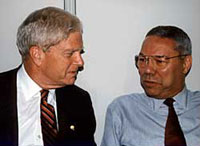
At the American Library Association's Annual Conference in New Orleans, Dr. Billington talks with retired Gen. Colin Powell following their presentations at the opening session. Dr. Billington spent two days at the conference, meeting with librarians and promoting the Library's Bicentennial.
Today, service to other libraries is a vital Library of Congress function. Many people do not realize, however, that the Library did not become directly involved with the American library movement until the beginning of its second century, during the early years of the administration of Librarian of Congress Herbert Putnam (1899-1939).
Librarian Ainsworth Rand Spofford, who built the Library into a national institution between 1864 and 1897, had neither the time nor the inclination to pay much attention to other libraries. He was too busy building the Americana collections and obtaining a separate library building. An old-fashioned book man, he also had mixed feelings about the emerging library "profession," which emphasized library techniques and issues related to management and organization. When the American Library Association was created in 1876, he agreed to serve as an officer but tried to avoid attending the organizational meeting "because I have always entertained insuperable objections to figuring in conventions (usually mere wordy outlets for impracticables and pretenders.)"
Much has changed since then.
All the Librarians of Congress since Herbert Putnam have viewed the library community as a key Library of Congress constituency. The connections were especially close during the administrations of Librarians of Congress Luther H. Evans (1945-1953) and L. Quincy Mumford (1954-1974.) Since the 1960s, when its international activities expanded dramatically, the Library has become increasingly involved with libraries and librarianship around the world.
Libraries in the Bicentennial Commemoration
Recognizing the need for sustaining solid relationships with the library community, the Bicentennial Steering Committee asked various library groups for advice on how best to involve libraries in the commemoration. Seven leaders from different segments of the American library community, for example, offered their suggestions in San Francisco during a program at the annual conference of the American Library Association (ALA). Forums also were held with other library groups, including federal, research, state and urban library associations. The result was the adoption of the "Libraries, Creativity, Liberty" Bicentennial theme. The Steering Committee felt that this broad theme accurately encompassed the Library of Congress's key role in promoting creativity in the preservation, organization and dissemination of much of the nation's recorded knowledge; and the Library's important role -- in the Jeffersonian sense -- of connecting knowledge and information to the responsibilities of citizenship in a democracy.

Two key library projects have been the development of a joint Library of Congress-ALA 12-page Tip Sheet for promoting libraries and building partnerships and a Library of Congress Toolkit (left) for libraries. Both were distributed at the ALA annual conference in New Orleans and are available without charge from the Library of Congress by calling (800) 707-7145 or (202) 707-2000 or by e-mail: bicentennial@loc.gov. The Toolkit includes a colorful "Why Do You Love Libraries?" poster, a "Celebrating America's Libraries" history fact sheet, a "What the Library of Congress Does for You" fact sheet, a stand-up guide to the Library of Congress's American Memory collections and sign up sheets for several Bicentennial-related projects.
Major Library of Congress Bicentennial projects involving libraries include "Beyond Words: Celebrating America's Libraries," a national photo contest sponsored by ALA and the Library of Congress (see LC Information Bulletin, July 1999); "John Bull and Uncle Sam: Four Centuries of British-American Relations," a joint exhibition with the British Library that will open at the Library of Congress on Nov. 16, 1999; "National Libraries of the World: Interpreting the Past, Shaping the Future," a symposium at the Library of Congress on Oct. 23-27, 2000; and a symposium on library preservation and security on Oct. 30-31, 2000.
Defining Moments
From Nov. 16 to Dec. 7, 1896, on the eve of the Library of Congress's move from the U.S. Capitol building to its own separate structure (today's Jefferson Building), the U.S. Congress held hearings about the Library's "condition" and future. Several professional librarians testified, some of them representing ALA. Witnesses included Melvil Dewey, then director of the New York State Library, and Herbert Putnam, then the head of the Boston Public Library. The hearings brought forth a richly detailed description of the Library's history and operations from Librarian of Congress Spofford, whose testimony fills 108 printed pages. Dewey and Putnam, representing the new library profession, testified about the desirable functions of an American national library. Both men carefully avoided direct criticism of Spofford, but nonetheless their view of the proper functions of a national library clearly differed from those of the Librarian of Congress.

The Library of Congress began serving other libraries during the administration of Librarian of Congress Herbert Putnam. - Frances Benjamin Johnston
Putnam wholeheartedly endorsed Dewey's description of the desirable role of a national library as "a center to which the libraries of the whole country can turn for inspiration, guidance and practical help, which can be rendered so economically and efficiently in no other possible way." Centralized cataloging, interlibrary loan, a national reference and bibliographic center, a national union catalog and a center for the international exchange of research materials were among the needed functions described by both men.
On June 30, 1897, President McKinley nominated a former journalist and diplomat, John Russell Young, to be the new Librarian of Congress. When he took office on July 1, Young named the 72-year old Spofford as chief assistant librarian. Young died in office on Jan. 17, 1899, and after much political maneuvering and several false starts, President McKinley nominated the ALA-backed candidate, Boston librarian Herbert Putnam, to be Librarian of Congress.
Two years later, Putnam was ready to add American libraries to the list of Library of Congress constituencies. During the 1901 ALA annual conference, in a talk titled "What May Be Done for Libraries by the Nation," he declared, "If there is any way in which our National Library may 'reach out' from Washington, it should reach out." By the end of the year, he had initiated a new classification system and published its first classification schedule, inaugurated the sale of Library of Congress printed cards to other libraries and established an interlibrary loan system. Additional services to libraries soon followed.
The appointment and administration of Herbert Putnam firmly linked the policies of the Library of Congress with the broader interests of American librarianship, particularly as those interests were expressed by the American Library Association.


