



When John and Ruby Lomax left their vacation home on San José Island at Port Aransas, Texas, on March 31, 1939, they already had some idea of what they would encounter on their three-month, 6,502-mile journey through the southern United States collecting folk songs.
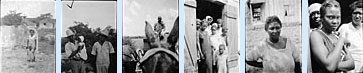
Portraits of African Americans taken during Lomax's folk song recording expeditions in Louisiana and Texas between 1934 and 1950
Many of the people and places they planned to visit were already familiar to them, and while they were always on the alert for previously unrecorded musical genres, songs and tunes, one of the purposes of this trip was to record some of their favorite folk songs and folk singers from past expeditions on state-of-the-art equipment. The Library of Congress provided the Lomaxes with the latest in recording technology: a portable Presto disc-cutting machine, with extra batteries and a supply of blank 12-inch acetate discs and sapphire needles that could be replenished upon request. Hauling this heavy equipment to and from the trunk of their Plymouth as they stopped to make recordings in schools, churches, homes, hotels, prisons and even along the roadside in locales throughout the rural South, they could hardly have suspected that, in 60 years' time, the cultural heritage they were collecting for deposit in the Archive of American Folk Song at the Library of Congress would be played back, with the click of a mouse button, through computer speakers in homes, schools and offices around the world, at the Library's Web Site.
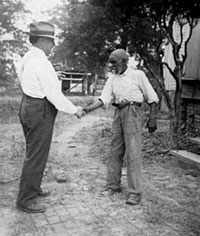
Uncle Rich Brown (right) and John Lomax at the home of Julia Killingsworth near Sumterville, Ala., Oct. 1940. - Ruby T. Lomax
John Avery Lomax, born Sept. 23, 1867, in Goodman, Miss., had been collecting songs since his childhood in Bosque County, Texas, jotting down lyrics to cowboy songs as he listened. At the University of Texas at Austin, however, where he studied English literature, one disdainful professor temporarily squelched his enthusiasm for the vernacular lyricism of the Texas frontier. By 1906, he was a graduate student at Harvard University, and professors Barrett Wendell and George Lyman Kittredge actively encouraged Lomax to document his native folklife. The subsequent documentation effort resulted in Cowboy Songs and Other Frontier Ballads (New York: Sturgis & Walton Co., 1910), published to critical and popular acclaim. Indeed, as the Lomaxes wrote in their field notes for the 1939 expedition, on at least one occasion John's book preceded him into the home of a performer. Elmo Newcomer, a fiddler and dance caller recorded in Bandera County, Texas, on May 3, 1939, remarked upon meeting John,
"Shake, boy. I've heared about you all my life ... We scraped our savings together an' sent 'em to you an' sure 'nough here come the book. ... We read it and sung from it so much and loaned it out so much that it's might nigh tore up." There was the book of cowboy songs, no two pages hanging together, but apparently all there between the covers, one of the 1910 edition (1939 Southern Recording Trip Fieldnotes, Section 9: Pipe Creek, Bandera and Medina, Texas; May 3-7, p. 120).
John Lomax married Bess Brown in 1904, and they had four children: Shirley (1905), John Jr. (1907), Alan (1915) and Bess (1921). Lomax taught English at Texas A&M University, researched and collected cowboy songs and, with Professor Leonidas Payne of the University of Texas at Austin, co-founded the Texas Folklore Society, a branch of the American Folklore Society. The Texas Folklore Society's founding members shared with Lomax a sense that their state's rich folklore needed to be documented and preserved for the analysis of later scholars. Nascent technology such as the radio and the gramophone, it was feared, would end the age-old tradition of transmitting music and lore directly from one person to the next. With professional musicians' works being piped into homes across the country, the purity of traditional music, its particularities of region, religion and ethnicity, could be lost forever. Ultimately, Lomax, often accompanied by his son Alan or by his second wife, Ruby, collected more than 10,000 recordings for the Archive of American Folk Song at the Library of Congress. Ironically, he relied on the latest technological advances to document the very oral tradition he feared technology would destroy.
Circumstances took John Lomax away from his beloved Texas in 1917, when he accepted a job as a banker in Chicago. When Bess Brown Lomax died in 1931, a full-scale return to folklore studies, as a lecturer and folk song researcher, gradually revived the despondent John Lomax. The Macmillan publishing company accepted his proposal for an all-inclusive anthology of American ballads and folk songs, and in the summer of 1932 he traveled to Washington to do research in the Archive of American Folk Song at the Library of Congress.
By the time of Lomax's visit, the archive already contained a collection of commercial phonograph recordings and wax cylinder field recordings of folk songs, acquired under the leadership of Robert Winslow Gordon, head of the archive, and Carl Engel, chief of the Music Division. Gordon had also developed and experimented in the field with a portable disc recorder.
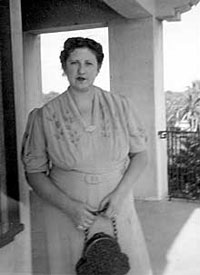
Isabella Salazar at Casa Ricardo Hotel, Kingsville, Texas, September 1940 - Ruby T. Lomax
Lomax made an arrangement with the Library whereby it would provide recording equipment (including recording blanks), in exchange for which he would travel the country recording songs to be added to the archive. Thus began a 10-year relationship with the Library that would involve not only John but the entire Lomax family.
Thanks to a grant from the American Council of Learned Societies, Lomax was able to set out in June 1933 on his first recording expedition under the Library's auspices, with Alan (then 18 years old) in tow. John and Alan toured Southern prison farms recording work songs, reels, ballads and blues from prisoners, whom they believed represented an isolated musical culture "untouched" by the modern world. One of their great discoveries occurred that July, when they recorded a 12-string guitar player by the name of Huddie Ledbetter, better known as "Lead Belly," at the Louisiana State Penitentiary at Angola.
Throughout that summer, as John Lomax traveled across the South, pursuing his lifelong interests, he courted Ruby Terrill by mail. They were married on July 21, 1934, in Commerce, Texas.
Ruby Terrill, called "Miss Terrill" by John Lomax even after their wedding, first met her future husband in 1921. A native Texan, she was dean of women and instructor of classical languages at East Texas State Teachers College in Commerce, Texas, when John Lomax lectured there on his cowboy song research. After she gave him and his young son, Alan, a tour of Commerce, he enlisted her as a babysitter. More than a decade later, the widowed John Lomax reintroduced himself to Miss Terrill, now a classical languages M.A. from Columbia University; co-founder of the pioneering woman educator's professional society, the Delta Kappa Gamma Society International; dean of women at the University of Texas at Austin; and Alan Lomax's Latin instructor.
His newlywed status did not prevent John Lomax from continuing to make disc recordings of musicians throughout the South. In 1934 he was named honorary consultant and curator of the Archive of American Folk Song, and he secured grants from the Carnegie Corporation and the Rockefeller Foundation, among others, for continued field recordings. As Lomax continued his work, his field expeditions reflected his broadening scope of interest, to the benefit of documentary history. For example, in 1934 he and Alan recorded Spanish ballads and vaquero songs on the Rio Grande border and spent weeks among French-speaking Acadians in southern Louisiana. In 1936 he was assigned to serve as an adviser on folklore, collecting for both the Historical Records Survey and the Federal Writers' Project, two Works Progress Administration agencies. As the Federal Writers' Project's first folklore editor, Lomax directed the gathering of ex-slave narratives and devised a questionnaire for FWP field workers to use.
Meanwhile, Ruby Terrill Lomax continued working at the university, overseeing the home and family and taking care of a number of duties for her husband's research. In 1937 she decided to exchange the academic pursuits and frenetic schedule of her life in Austin for the intellectual pursuits and equally frenetic pace of life on the road with a ballad hunter. The Lomaxes made a house outside Dallas (called the "House in the Woods") their permanent residence, then drove away in Ruby's Plymouth on a scouting tour of the Southern states. The classics scholar evidently enjoyed the expedition, and threw herself wholeheartedly into it.

Frank Goodwyn, Kingville, Texas, September 1940. - Ruby T. Lomax
Ruby Terrill Lomax's role in the success of the 1939 Southern States Recording Trip cannot be overemphasized. She composed nearly all written documentation relating to the collection. She cataloged the contents of each disc on the record's dust jacket as the recording was taking place. According to Frank Goodwyn, a ranch hand who sang cowboy songs for the Lomaxes in April 1939, Miss Terrill operated the Presto machine while John instructed and encouraged the performers (interview with Frank and Elizabeth Goodwyn, April 29, 1999, AFC 1999/006).
After the trip, at the Library of Congress she transcribed song lyrics and composed and typed much of the 307 pages of field notes. In addition, Ruby's voice can be heard on a number of the recordings, carefully announcing the performer's name and the date and location of the recording. While her husband possessed the contacts, the title of honorary consultant and curator of the Archive of American Folk Song and the expert knowledge of the material he was seeking and collecting, Ruby Lomax possessed the organizational and archival skills of a longtime administrator and instructor, the wide-eyed wonder of a lifelong learner uncovering a whole new world of studies and the social skills of a parliamentarian who was a key player on many teams.
In 1940, when the couple traversed the same path through the South, she took on the additional role of photographer. Many photographs from the 1940 recording expedition illustrate the American Memory online presentation featuring the 1939 recordings.
John and Ruby Lomax began their 1939 Southern states recording expedition in Texas, stopping in 12 counties in 712 weeks (more than half of the trip) to capture some 350 blues songs, corridos, fiddle tunes, lullabies, play-party songs and railroad, riverboat and prison work songs in settings ranging from a storage garage in Houston to schoolyards in Brownsville and Wiergate to the Ramsey State Farm in Otey, where prisoners were "under guard, behind three sets of locks" (1939 Southern Recording Trip Fieldnotes, Section 5: Ramsey State Farm, Otey, Texas; April 23, p. 48).
Mechanical difficulties delayed and damaged some recordings, as the Lomaxes' correspondence with the Music Division documents. For example, their attempts to record the religious drama Morir en la cruz con Cristo, o Dimas, el buen ladrón on Easter Sunday in Houston were foiled by failing batteries; they visited the López family at their home in Sugar Land two weeks later to capture the entire drama.
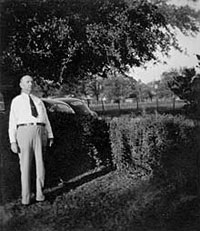
H.R. Weaver singing "Ox-Driving Song" at his home in Merryville, La., October 1940 - Ruby T. Lomax
Merryville, La., their first stop outside of Texas, had been suggested by John's son Alan (employed as assistant in charge of the Archive of American Folk Song since 1937) and his wife, Elizabeth. "Elizabeth's uncle lives in a little town in the no-man's-land on the Texas edge of Louisiana. Elizabeth says that he has a natural amateur's interest in folk songs and knows all the fiddlers and singers of that section, and he could probably lead you to very good material" (Letter from Alan Lomax to John A. Lomax; Port Aransas, Texas, Jan. 21, 1939). Herman R. "H.R." Weaver did prove a valuable contact, offering his home as a recording studio, guiding the Lomaxes to the blind gospel pianist J.R. Gipson and the New Zion Baptist Church congregation and singing a few traditional songs he had learned from his father.
The Arkansas and Mississippi state prisons, Cummins and Parchman, provided a wealth of material, although evidently less than they had for Lomax in the past. Ruby Terrill Lomax described these prison farm recording sessions in a letter written to her family:
We consider that we had rather a lucky excape [sic] from the Cummins State Farm in Arkansas; the night after we left a storm blew one of the stockades down, such as the ones in which we set up our machine to work. ... Twelve convicts escaped in the confusion and two, at latest account that we saw in the papers, were killed in trying to escape. We made some pretty good records, but even in the past two years the death rate of old songs has risen. ... At Parchman we found the superintendent harassed by personal and political problems, so that we did not tarry very long after working with two camps. Fortunately for us, rain kept the boys out of the fields so that we were able to do our work by day instead of at night (1939 Southern Recording Trip Fieldnotes, Section 14: Cummins State Farm, near Vainer, Ark.; May 20-21, p. 205).
Alabama provided a more hospitable environment for the traveling couple, now two months into their expedition. John and Ruby Lomax spent five days in Sumter County, Ala., assisted, guided and introduced to performers by their friend Ruby Pickens Tartt, local folklorist and chairman of the WPA Federal Writers' Project of Sumter County. Tartt facilitated the recording of 115 children's songs, hollers, play-party songs, religious oratory and spirituals, many of which were recorded on the porch and in the yard of her home at Baldwin Hill in Livingston. The Lomaxes were glad that the Presto machine was in good working order, as they were able to better document the repertoire of the cousins Vera Hall and Dock Reed, whose mellifluous singing voices have graced numerous Library of Congress acetate discs prior to and after 1939.

African American convicts working with shovels, possibly singing "Rock Island Line" at Cummins State Farm, Gould, Ark., 1934. - Ruby T. Lomax
In Florida, the Lomaxes revisited Mrs. G.A. Griffin, who sang old ballads and demonstrated her unique manner of calling chickens. They also recorded at the State Farm at Raiford. Ruby Lomax was barred by the superintendent from making recordings with John in the men's dormitory but captured some fine examples of blues songs and singing game songs from the women prisoners.
A polio epidemic in South Carolina prevented the Lomaxes from recording large groups of schoolchildren in that state, as planned, but they nevertheless collected 49 songs in three counties. At the home of another WPA Writers' Project contact, Genevieve W. Chandler, along the Atlantic coast at Murrells Inlet, they collected Anglo-American ballads from Minnie Floyd and African American singing game songs and spirituals from schoolteacher Annie Holmes and several of her students. In Clemson, S.C., host Ben Robertson gathered two groups at his home to sing children's songs and religious songs and escorted the Lomaxes to the Little Hope School House to record the church congregation gathered there. While driving through Anderson County, John and Ruby were appalled to see a chain gang of approximately 80 prisoners connected by an ankle chain; they recorded the group singing spirituals and work songs and composed a letter to the governor to protest this inhumane practice.

Ruby Pickens Tartt at her home in Livingston, Ala., October 1940 - Ruby T. Lomax
At the urging of their Clemson host, Ben Robertson Jr., John and Ruby Lomax spent an afternoon at the Georgia-Carolina Singing Festival in Toccoa Falls, Ga. The festival setup was a far cry from the intimate settings in which they were accustomed to making their recordings, and the distinction between the festival performances and the types of songs they were seeking plagues the classification of "folk" music to this day:
After lunch we drove to Toccoa Falls, Georgia where a huge crowd had gathered from three states, about twenty thousand. ... Loud speakers made the singing audible over several acres. It was a great social gathering, a veritable reunion. It was impossible to choose wisely. After listening for a long time on the outside, Mr. Lomax chose two quartets, one of women, one of men, for recordings. They were conducted to a building where the machine was set up. The records were made in the midst of much noise and confusion. The songs are not folk songs, but the records illustrate a manner- kind of religious song and a manner of singing them that are currently popular in some small town and rural districts (1939 Southern Recording Trip Fieldnotes, Section 21: Clemson, S.C., and vicinity; June 9-12, p. 297).
John and Ruby Lomax drove through North Carolina on June 13, arriving in Galax, Va., in the late afternoon. Dr. W.P. "Doc" Davis, director of the Bog Trotters Band, was ill, so the Lomaxes' plans to record the band were stymied, but they nonetheless enjoyed the beautiful trip through the mountains and the company of the band members. They arrived at the Library of Congress on June 14, and there deposited the 142 discs proclaimed by Alan Lomax to be "musically and acoustically ... one of the best groups of records accessioned in the Archive" (1939 Annual Report: Excerpt from the Archive of American Folk-Song Annual Report, 1928-1939, p. 70).
John Lomax summarized the trip as follows:
... in many instances we re-recorded folk songs sung in a different manner, or slightly different musically from already known material. In visiting the homes, schools and churches of the Southern folk and recording their singing in their own locale, we carried out the theory of the Folk Song Archive of the Library of Congress, namely, that folk singers render their music more naturally in the easy sociability of their own people (1939 Southern Recording Trip Report, p. 1).
The online presentation of Southern Mosaic: The John and Ruby Lomax 1939 Southern States Recording Trip fulfills the mission of the American Folklife Center of the Library of Congress, "to preserve and present American folklife" (Public Law 94-201, 1976). By making these recordings available to a wider audience of students, researchers, musicians, folklorists and more, the musical heritage John Lomax and his family devoted themselves to documenting is being passed on to new generations.
The collection's 686 sound recordings, as well as the accompanying field notes, dust jackets, correspondence and song texts, can be accessed from the American Memory Collections of the National Digital Library Program. Photographs taken during other Southern states recording trips illustrate the online presentation, which is made possible by a donation from the Texaco Foundation.
Bartis, Peter T. "A History of the Archive of Folk Song at the Library of Congress: The First Fifty Years." Ph.D. diss., University of Pennsylvania, 1982.
Lomax, John A. Adventures of a Ballad Hunter. New York: Macmillan Co., 1947.
Porterfield, Nolan. Last Cavalier: The Life and Times of John A. Lomax, 1867-1948. Urbana, Illinois: University of Illinois Press, 1996.


