


Manuscripts
Manuscript Division
Gettysburg Address
[Gettysburg Address]


Seen here is the earliest known of the five drafts of what may be the most famous American speech. Delivered by President Abraham Lincoln in Gettysburg, Pa., at the dedication of a memorial cemetery on November 19, 1863, it is now familiarly known as "The Gettysburg Address." Drawing inspiration from his favorite historical document, the Declaration of Independence, Lincoln equated the catastrophic suffering caused by the Civil War with the efforts of the American people to live up to the proposition that "all men are created equal." This document is presumed to be the only working, or pre-delivery, draft and is commonly identified as the "Nicolay Copy" because it was once owned by John George Nicolay, Lincoln's private secretary. The first page of this copy is on White House (then Executive Mansion) stationery, lending strong support to the theory that it was drafted in Washington, D.C. But the second page is on what has been loosely described as foolscap, suggesting that Lincoln was not fully satisfied with the final paragraph of the Address and rewrote that passage in Gettysburg on November 18 while staying at the home of Judge David Wills.
Treatment: The Top Treasures are stored in a cold storage vault in the Conservation Division. Each treasure is housed in a protective enclosure. The lack of oxygen and the cold temperature and stable humidity inside of the vault extends the life of these documents by several hundred years. The temperature in the vault is 50 degrees F. The relative humidity is 50%. These are ideal conditions for paper documents.
George Mason's Declaration of Rights
George Mason
[Mason's Declaration of Rights]
May 1776

A call for American independence from Britain, the Virginia Declaration of Rights was drafted by George Mason in May 1776 and amended by Thomas Ludwell Lee and the Virginia Convention. Thomas Jefferson drew heavily from this document when he drafted the Declaration of Independence one month later.
Mason wrote that "all men are born equally free and independent [sic], and have certain inherent natural rights,...among which are the Enjoyment of Life and Liberty, with the Means of acquiring and possessing Property, and pursuing and obtaining Happiness and Safety."
This uniquely influential document was also used by James Madison in drawing up the Bill of Rights (1789) and by the Marquis de Lafayette in drafting the French Declaration of the Rights of Man (1789).
Treatment: The Virginia Declaration of Rights is one of the Library's Top Treasures and is stored in a cold vault. Select Top Treasures are housed in sealed enclosures with argon, an inert gas that displaces oxygen. The lack of oxygen and the cold temperature and stable humidity inside of the vault extends the life of these documents by several hundred years. The temperature in the vault is 50 degrees F. The relative humidity is 50%. These conditions are ideal for paper documents.

Rough Draft of Declaration of Independence
Thomas Jefferson
[Rough Draft of the Declaration of Independence]
1776

The "original Rough draught" of the Declaration of Independence, one of the great milestones in American history, shows the evolution of the text from the initial "fair copy" draft by Thomas Jefferson to the final text adopted by Congress on the morning of July 4, 1776.
On June 11, in anticipation of the impending vote for independence from Great Britain, the Continental Congress appointed five men—Thomas Jefferson, John Adams, Benjamin Franklin, Roger Sherman, and Robert Livingston—to write a declaration that would make clear to all the people why this break from their sovereign, King George III, was both necessary and inevitable.
The committee then appointed Jefferson to draft a statement. Jefferson produced a "fair" copy of his draft declaration, which became the basic text of his "original Rough draught." The text was first submitted to Adams, then Franklin, and finally to the other two members of the committee. Before the committee submitted the declaration to Congress on June 28, they made forty-seven emendations to the document. During the ensuing congressional debates of July 1-4, Congress adopted thirty-nine further revisions to the committee draft.
The four-page "Rough draught" illustrates the numerous additions, deletions, and corrections made at each step along the way. Although most of these alterations are in Jefferson's own distinctive hand—he later indicated the changes he believed to have been made by Adams and Franklin—he opposed many of the revisions made to his original composition.
Late in life Jefferson endorsed this document: "Independence. Declaration of original Rough draught."
Treatment: The Rough Draft of the Declaration of Independence has been frequently handled and exhibited over its 224 year life span. It was treated previously on at least 3 occasions as well. This complex past called for a thorough technical and historical analysis of the document's condition, carried out by the Conservation and Research and Testing Offices in 1997. Presently the Rough Draft is housed in a custom-built, argon-containing display case designed to retard oxidation and acid hydrolysis. Housing the manuscript in an inert gas environment with stable relative humidity minimizes the aging which would occur under ambient environmental conditions.
The Wolfman
Sergei Pankejeff
[The Wolfman]
Pastels. S. Freud Collection.

This drawing is by Sergius Pankejeff, one of Sigmund Freud's most famous patients. Through Freud's analysis, Pankejeff's wolf dreams proved to be the key to understanding his childhood neuroses.
Treatment: Conservators mended the pastel drawing, cleaned it and re-housed it in special sink mats designed to protect the delicate surfaces.
The Tristram Saga
William Dudley Foulke
[Tristram's Saga]
Vellum fragment in Icelandic, 15th century

During the 12th-century, Norwegian kings sent scribes to France to transcribe Charlemagne tales and other contemporary romances. Among these was the Celtic-French Tristram or Tristan legend, which in part told of the love between a handsome nephew and his uncle's beautiful wife.
Translated into Old Nordic, the Tristram saga evolved into a Scandinavian myth independent of the Celtic-French-English one. From the Old Nordic, the saga has been preserved in three versions, one of which was Icelandic. This vellum fragment represents a late-fifteenth-century Icelandic version.
The Library's fragment has two leaves, of which half the first is missing. Another fragment, in the Copenhagen University Library, has three leaves, one of which is incomplete. Both manuscripts measure 16.4 x 11.9 centimeters and have the same number of lines to a side. The Library's manuscript is known in some scholarly circles as "The Reeves Fragment" because it was found by Icelandic scholar Arthur Middleton Reeves (1856-1891), brother of Mrs. William Dudley Foulke, stitched into the back of a book. The manuscript, donated to the Library of Congress in 1965 by Reeves's grandniece Phoebe Cates of Paris, France, was placed in the papers of his brother-in-law William Dudley Foulke (1848-1935), a lawyer, public official, and Progressive-era reformer. Other Reeves material in the Foulke Papers includes the scholar's diary of his 1879 Iceland trip.
Treatment: This item has extremely interesting information on both sides. For this reason, it was placed into a double side mat to allow researchers to view each side without causing stress to the item. The item is difficult to read, so two color photographic enlargements are included in the double sided mat to facilitate use.
Margaret Mead Collection
Margaret Mead
[Margaret Mead Collection]


Margaret Mead (1901-1978) was a prominent twentieth-century educator, writer, and lecturer. An anthropologist by occupation, she studied the lives of natives of Samoa, Indonesia, and Papua New Guinea. Her first book, Coming of Age in Samoa: A Psychological Study of Primitive Youth for Western Civilization (New York: Morrow, 1928), which compared the seemingly care-free adolescent years in Samoan culture to this stressful period of development for American teenagers, catapulted her to instant fame. As she went on to research and write about other cultures, she used these anthropological studies as a framework to discuss and analyze American society.
Mead was greatly influenced by the highly educated women in her family, especially her grandmother and mother. In this letter to her grandmother, Martha Ramsay Mead, written shortly after Mead's marriage to her first husband Luther Sheeleigh Cressman (1897-1994) in 1923, Mead mentions her decision to keep her maiden name, a practice she followed through three marriages. In her autobiography, Blackberry Winter: My Earlier Years, Mead wrote that she made the decision to retain her name based on her "mother's belief that women should keep their own identity and not be submerged, a belief that had made her give her daughters only one given name, so that they would keep their surnames after marriage."
The papers of Margaret Mead were bequeathed to the Library of Congress upon her death in 1978. The entire collection comprises approximately five hundred thousand items and includes thousands of photographs, more than a thousand pieces of recorded sound tapes and cassettes, and over five hundred reels of motion picture film. The Library of Congress is presently working on a project to digitize and make available over the Internet approximately thirty-two thousand photographs and twenty thousand pages of selected field notes that document her field expedition to study the Balinese in Indonesia and the Iatmul people of Papua New Guinea from 1936 to 1939.
Treatment: Conservators removed the Balinese drawings from poor quality exhibit mats, and treated them to remove pressure-sensitive tape residue. They then re-matted and boxed items using conservation quality materials.
George Patton Collection
Gen. George S. Patton
[Diaries]
March 1943

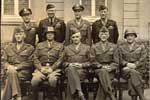
One of the military innovations of World War I was the emergence of the armored tank. George S. Patton, Jr. (1885-1945), was the first American officer assigned to the fledgling United States Tank Corps in 1917. He continued to champion the tank in years between the wars when the money-short army largely neglected the corps. In World War II in Europe and North Africa, however, the tank and armored warfare quickly emerged as the most decisive means of land warfare. With this development, Patton moved into the spotlight and soon distinguished himself as America's most successful combat commander of armored troops.
During World War II, Patton kept a diary in which he noted his activities and observations. It is a remarkably candid work and an indispensable source of information not only on Patton himself but on American ground combat operations in North Africa and Europe from 1942 to 1945.
Treatment: Conservators flattened, encapsulated, and post-bound the contents of eleven World War II diaries into individual matching albums.
Mission to China
Caleb Cushing Papers
[George R. West]
Watercolor, 1844

The Buddhist Temple of the Goddess of Mercy, located in the settlement of Wang-Hsia on the island of Macao, the Portuguese colony lying off the delta of the Canton River, was the site of the signing of the Treaty of Wang-Hsia. Caleb Cushing (1800-1879), of Newburyport, Massachusetts, a United States representative prior to his mission to China, successfully negotiated this first treaty between the United States and China.
Signed on 3 July 1844, it won the same concessions that the British had gained in the Treaty of Nanking following the conclusion of the Opium War in 1842. Five treaty ports were to be opened to United States trade, and the principle of extraterritoriality was set forth, whereby United States citizens living in China would be tried by the United States consul in accordance with the laws of the United States.
The watercolor on paper of the Buddhist Temple at Wang-Hsia was painted by George R. West (1811-1877), who was included in Cushing's diplomatic entourage as an official painter. It is one of many paintings in the Cushing Papers relating to the 1844 mission.
Treatment: The watercolor was encapsulated and placed in a window mat to provide support while permitting ease of access. The mats are stored within a box specially designed to provide a museum quality environment and the strength needed to support the heavy matted items.
Steamship to Japan: 1852
Matthew Perry
[Speiden Journal]
1854


This two-volume set of journals is filled with images ranging from hand drawn, pen-and-ink scenes of everyday life to exquisitely colored and detailed pith paintings created for the tourist industry. The journals were kept by William Speiden, the purser's clerk during Matthew Perry's naval expedition to Japan in 1852-54. In this "Journal of a Cruise in the U.S. Steam Frigate Mississippi," Speiden provided a detailed account of the reception given to Commodore Perry and of deliberations between Perry and representatives of the emperor of Japan.
Treatment: Typical of volumes used for scrapbooks, the added contents expand the thickness of the volumes and cause the bindings to break. The pith paintings contained in these volumes are particularly vulnerable to damage because they are thin, brittle and unsuited to the movable pages of the book format. Conservators preserved the paintings by removing them from the books and storing them in specially designed mats. They inserted facsimile images in the book in place of the original paintings. This solution reduced some of the extra bulk in the text block, thereby allowing the remaining pages to be successfully rebound.
Alaskan Russian Orthodox Church Collection
Alaskan Russian Orthodox Church Collection
[Iconostasis of St. Michael's Cathedral]
Pencil/color wash, 1844

Sitka was the capital of Russian America and the cathedral the center of the Alaskan Russian Orthodox Church, which directed its efforts towards the conversion and education of the native peoples, especially in the period prior to Alaska becoming an American territory.
Treatment: This drawing was dry cleaned, mended, and placed in a in window mat for support.
Gladstone African American History Collection
[Records of African Americans in the Military]
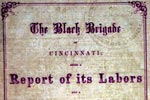


The William A. Gladstone Collection documents African Americans in military service, especially in the United States Corps d'Afrique and the United States Colored Troops, which were organized during the Civil War. Also included are Revolutionary War pay vouchers issued to Connecticut blacks who served in the Continental Army.
Treatment: Conservators dry cleaned items in the collection and deacidified them when possible. They mended some using Japanese tissue and wheat starch paste. They placed the collection in polyester sleeves and stored them in acid-free folders and boxes.
Benajah Jay Antrim Journals
Bound volumes, 19th century


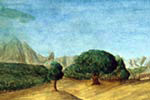
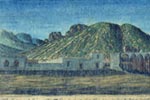
These diaries, journals, and sketchbooks provide not only a travelogue of places visited but insight into the inspiration, motivation, and perspiration during a journey from Philadelphia, Pennsylvania, to Mexico, and an overland journey across Mexico to the Pacific coast in 1849.
Treatment: The three manuscript journals and two sketchbooks, one with colored media, had all been laminated with cellulose acetate and tissue several years ago. Conservators delaminated all of the journals and washed and deacidified them, with the exception of the sketchbook with colored media. Two of the manuscripts were rebound in cloth case bindings. The third was too brittle for such a treatment and was put into a positioning structure with mylar encapsulations for the pages, covered with the same linen cloth.
A special handmade paper mat structure was developed for the two sketchbooks. Extended guards on the mat structure were sewn on tapes to create the new case style bindings, and a box housing all five volumes was constructed.
Spanish History
Hans P. Kraus Collection
Bound volumes


The Hans P. Kraus collection is significant not only for the wide range of information it contains about Spanish colonial history but for the light is sheds on the early history of the territories now included in the United States.
Treatment: Typical of the period, this limp vellum binding has yapp edges and fore-edge ties. The text block is a laid handmade paper sewn on alum-tawed thongs and end bands, which are used for lacing the text block into the vellum cover. Treatment included the construction of portfolios, and boxes for individual items.
A Jefferson Pen Pal
J. Henley Smith
[Henley-Smith Collection]
Manuscript, 18th c.


J. Henley Smith was editor of the National Intelligencer and a confidante of Thomas Jefferson's. The Smith Papers include many letters written by Jefferson and other important figures of the early 19th century.
Treatment: Conservators removed the manuscripts from their bindings, de-laminated, de-silked, and deacidified them. They mended tears using Japanese tissue. They used museum-quality materials to re-house the manuscripts.
Codex Amoretti, Vespucci Letter.
Hans P. Kraus
[Codex Amoretti, Vespucci Letter]
Letter, ca. 1504


An undated (ca. 1504) copy of a letter written by Amerigo Vespucci in which he narrates the much-disputed history of his four voyages. The copy reflects the interest of the great Florentine mercantile houses in learning more about the new regions and possible new routes to the Orient.
Treatment: Conservators cleaned the manuscripts and removed old repairs using methyl cellulose poultices. They mended tears using Japanese tissue and wheat starch paste.
Made in America
Women's Cottage Industry
[Ipswich Laces]
18th century

These 18th century American-designed and executed laces are from the women's cottage industry of Ipswich, Massachusetts.
Treatment: After consultation with the Textile Museum, conservators removed the laces from old paper supports and re-housed them in specially designed muslin-covered mats.
Designing Soldiers
Alexander Hamilton Collection
[U.S. Army Uniforms]
Manuscript
1790's
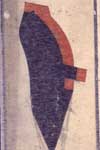
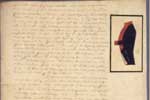


Andrew Hamilton was an aide to George Washington during the Revolutionary War and first Secretary of the Treasury. He served as a Major General under Washington in the 1790's during the John Adams's administration. This design for a U.S. Army uniform is in his collection, which resides at the Library.
Treatment: Conservators de-laminated, de-silked, and repaired the document using both heat-set tissue and Japanese tissue adhered with wheat starch paste.
Liber(ia)ate!
American Colonization Society
[Records]
Book and Paper Materials, 1822-1847


The American Colonization Society was founded in 1816 in Washington, D.C., to promote the repatriation of free African Americans to Africa. Accordingly, in 1822 the Society established a colony on the west coast of Africa, which in 1847 became the Independent Republic of Liberia.
While spanning the period 1792 to 1964, the majority of the society's correspondence, reports, and financial and business papers date from the years 1823 to 1912. Correspondence covers such subjects as administrative matters, the status of slaves and freedman in antebellum America, and the society's role in founding and colonizing Liberia and supporting Liberian education.
Treatment: The correspondence in the collection was originally arranged in bound volumes. In binding the volumes, the letters were sewn and the covers directly attached. These old bindings were in various stages of disintegration when the Library acquired the collection. Between 1936 and 1963 the Library rebound most of the correspondence volumes.


