


Background: Traditional leather book bindings of the renaissance and early modern era often used quarter sawn wooden boards, particularly for heavy, thick, or oversized volumes. “Quarter-sawing” takes only those slices from a log which are cut perpendicular to the growth rings, yielding a board of superior dimensional stability, but resulting in very few useable pieces per tree. These boards are becoming increasingly difficult to obtain, and the fiber boards used in contemporary binding lack the stiffness and strength required for some larger volumes. Thus, there is a need to identify a substitute material of similar dimensional stability to quarter-sawn wood for heavy volumes requiring conservation re-binding.
Project Description:Samples of gelatin sized fiber boards were prepared as laminates with different adhesives between layers (wheat starch paste, hide glue and epoxy). These laminates were exposed to accelerated aging at different temperature and relative humidity conditions. Physical properties including weight, thickness, length, width, delamination and warping were measured before, during and after aging. Results were compared to measurements taken on control samples of quarter sawn wooden boards.

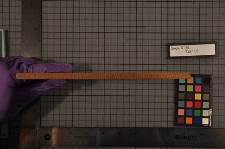
Left: Front face view of control wooden board sample.
Right: Edge-on view of control wooden board sample.

Outcomes: A report outlining the performance of the range of laminate samples is being prepared.


