


Background
Caretakers of collections holding 19th century glass artifacts are not always aware that glass may be an unstable material. Due to the sheer volume of historical artifacts in this category, especially as produced through 19th century photography, this represents a potential preservation problem of enormous consequence. For example, some studies on deterioration in wet collodion glass plate negatives have estimated that about 10% are made of unstable formulations that are responsible for deterioration. Other specialty glass objects from the 19th century have been observed to exhibit glass deterioration, including some of the exquisite and rare flutes made by Claude Laurent.
The latter glass musical instruments were in fact the impetus for this research project, which was initiated in 2014 as a technical study of the Laurent flutes in the Library’s Dayton C. Miller Collection. At that time, Carol Lynn Ward-Bamford, the Library of Congress’ (LC) Senior Curator of Musical Instruments, noticed a disturbing trend: some of the flutes appeared cloudy, a worrying sign of deterioration. Ward-Bamford subsequently requested analytical help from the Library’s Preservation Research and Testing Division. The ensuing work, led by Ward-Bamford and Lynn Brostoff, formed the basis of a major National Endowment for the Humanities grant, which supports a collaboration between Ms. Ward-Bamford, Dr. Brostoff and Dr. Fenella France at LC; Dr. Isabelle Muller and Dr. Andrew Buechele from the Catholic University of America’s Vitreous State Laboratory (VSL); and Dr. Murray Loew of George Washington University (GWU). The primary objective of this research is to develop a series of effective tools that, when organized into a decision-tree, assist curators, conservators and scientists alike in the identification of at-risk 19th century glass heritage. The decision tree and accompanying protocols will guide users in the examination of glass artifacts, starting with the use of microscopy and UV light, and advancing to common, non-invasive analytical tools, such as pH, X-ray fluorescence spectroscopy (XRF) and fiber optic reflectance spectroscopy (FORS).
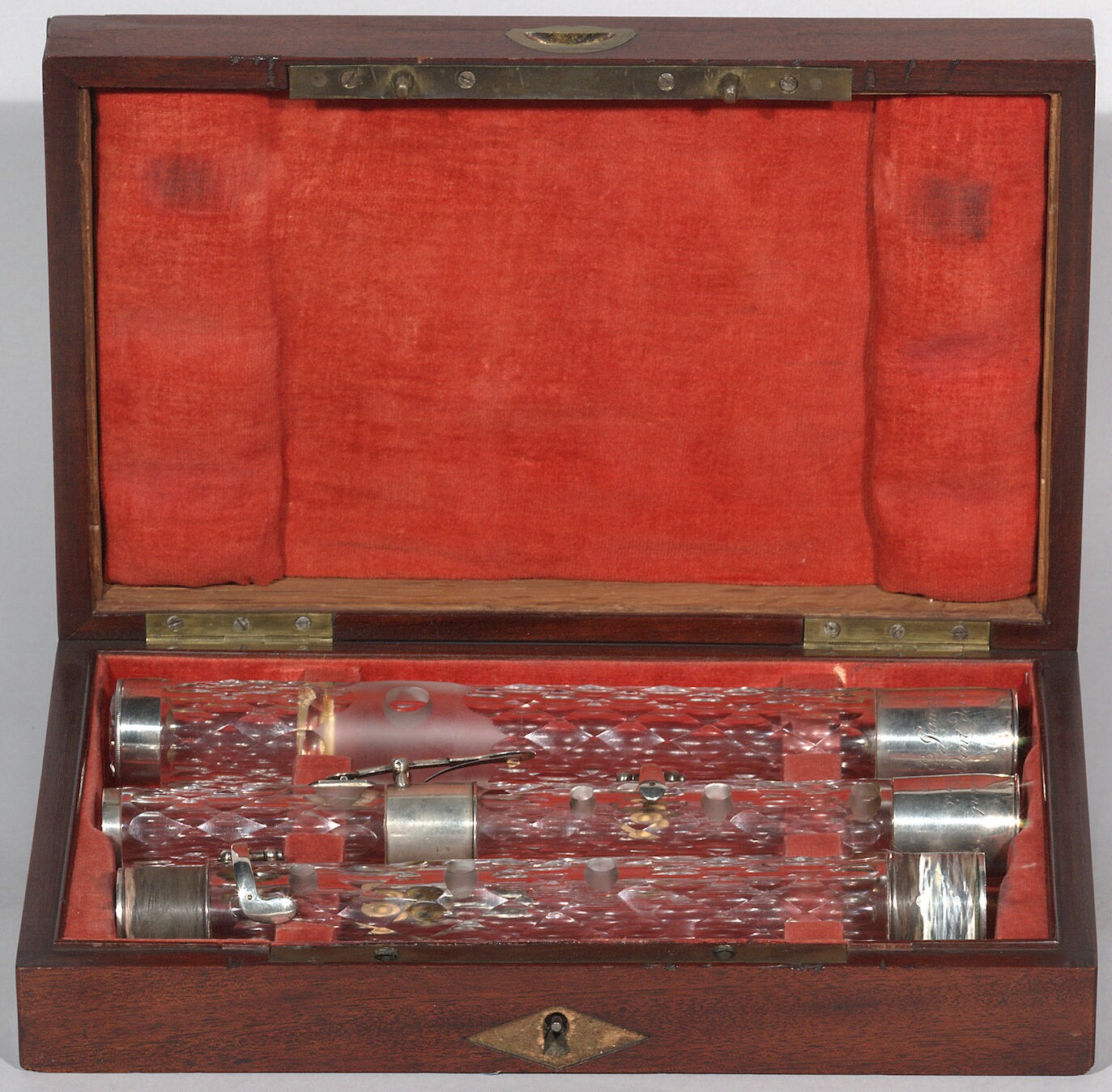
DCM 0378: Claude Laurent / Flute in C - view of flute in case | Library of Congress
Further Reading:
- Dayton C. Miller (1866 to 1941): American Acoustician, Physicist, Flutist, and Collector of All Things Related to Flutes
- Laurent Glass Flutes
- Claude Laurent and the Madison Flute: Discoveries through Archival Research
- Glass At Risk: Simple Tools for Detecting Unstable Glass in 19th-Century Cultural Heritage Collections
Contributing Studies
Allen, Erin. Anatomy of the Flute. Library of Congress Blog, Sept. 25, 2014.
Bahr, Katie. "Magical Flutes - Uncovering the Secrets of a National Treasure." CUA Magazine. 2014.
Brostoff, L.; Ward Bamford, C.L.; Diba, T.; Buechele, A.; Loew, M.; Zara, J. “Optical Coherence Tomography of 19th Century Glass: Facts and Phantoms.” Proceedings Volume 11058, Optics for Arts, Architecture, and Archaeology VII; 110580W (2019.) SPIE Optical Metrology, Munich, Germany, 2019. https://doi.org/10.1117/12.2526170
Brostoff, L.; Ward-Bamford, C.L.; Zaleski, S.; Montagnino, E.; Buechele, A.; Muller, I.; Diba, T.; Zara, J.; Loew, M.; France, F. "Characterization of the Surface Alteration Layer in 19th-Century Potassium Silicate Glass. Recent Advances in Glass and Ceramics Conservation." Proc. Of Working Group Interim Meeting, London, Sept. 5-7, 2019 (in press).
Brostoff, Lynn; Buechele, Andrew; Muller, Isabelle; Ward-Bamford, Carol Lynn; Xie, Xiaogang. 2015. "A Study of Glass Composition and Crizzling in Two Claude Laurent Glass Flutes from the Library of Congress." Microscopy and Microanalysisvol. 21, no. S3, 2015, pp. 1161–1162., doi:10.1017/S1431927615006595.
Ward-Bamford, Carol Lynn; Brostoff, Lynn; Klein, Dorie; Kivi, Nicholas; Perez, Ruhi; Muller, Isabelle S.; Buechele, Andrew C.; France, Fenella; Loew, Murray. "A New, Simplified Approach for Assessing Glass Musical Instruments." CIMCIM Bulletin: 6-12. January 2019.
Zaleski, S, Montagnino, E, Brostoff, L, et al. "Application of fiber optic reflectance spectroscopy for the detection of historical glass deterioration." J Am Ceram Soc. 2019; 103: 158– 166. https://doi.org/10.1111/jace.16703
Project Description
Study of glass musical instruments in the LC collections and other institutions worldwide has involved technical examination as well as extensive historical research, since little was known previously about Claude Laurent and his flutes. As part of the project, Lynn Brostoff (LC), Carol Lynn Ward-Bamford (LC) and Stephanie Zaleski (GWU) visited the Historical Society of Washington, D.C. (HSW) and the Virginia Museum of History and Culture (VMHC) to examine a representative portion of their 19th century glass photographic material collections. Objects were chosen using a random number generator in order to represent different types of glass found in the collections, including daguerreotypes, ambrotypes, cased tintypes, glass plate negatives and glass lantern slides.
Preliminary surveys of photographic glass in several historical society and library collections were conducted using portable XRF, UV flashlights and a camera adapted with a 10x magnification objective. Results of the preliminary surveys showed a much higher proportion of glass deterioration in cases or enclosures than was expected from the literature; deterioration was noted in the form of liquid droplets and precipitated salts on the underside of cover glasses. Most interesting is the discovery that even so-called stable soda-lime silicate glasses can form droplets and precipitates on the surface in such environments. These results have been compiled and presented at a recent conference of the American Institute for Conservation.
Technical study of the historical artifacts has been augmented by in-depth model glass studies led by partners at VSL. Using artificially-aged model glass made to replicate Laurent’s formulations and typical photographic glass compositions, these studies provide a refined understanding of the commonly accepted model of alkali-silicate deterioration as observed in historical 19th century objects.
Since 2014, a new database has been compiled that identifies 185 extant Laurent flutes in the world, along with compositional and condition information about the flutes. Technical studies of the 20 DCM flutes and 1 piccolo have been conducted with numerous non-invasive techniques, including light microscopy, XRF, FORS in the near infrared region, ultraviolet (UV) fluorescence spectroscopy, Raman spectroscopy, computed X-ray scanning, and optical coherence tomography (OCT).
Outcomes and Findings
The initial focus of our research efforts has been centered on glass flutes made in Paris by Claude Laurent in the first half of the 19th century. Twenty of these rare musical instruments are held in the Dayton C. Miller (DCM) collection at the Library of Congress. Compositional analysis of the DCM collection glass musical instruments has revealed that, contrary to common assumptions, only two Laurent flutes and one piccolo are made of “lead crystal,” (greater than about 27 wt.% lead (Pb) glass), while the others are potash glass (potassium (K) silicate glass with low calcium (Ca)). Ironically, while Laurent sought to improve flute stability through its manufacture in glass, his potash glass (12-18 wt.% K) material is inherently unstable. This is exemplified in model studies, which also support observations that the DCM high-leaded glass (i.e., “crystal glass”) flutes are relatively stable, especially in comparison with the potash glass flutes. Compositional and model studies furthermore suggest that the amount of K in potash glass contributes to inherent instability. The study also shows that UV illumination, with or without non-invasive XRF, can reliably detect and flag the latter type of glass flute, which is especially important for preservation assessment.
Results from the technical examination of Laurent flutes at LC and other institutions, along with 19th century glass photographic materials, highlight the fact that these types of objects are subject to considerable deterioration in collections worldwide. In particular, results confirm the widespread occurrence of compositionally unstable glass in different types of cultural heritage materials, and support the concept that the initial stage of low calcium, non-leaded glass deterioration is glass hydration in adverse environments. Of great concern is the fact that this stage is not discernible by visual inspection. Visible glass deterioration, on the other hand, i.e., intermediate to advanced deterioration, may be observed variously as fine cracking, dense networks of cracking on interior and exterior surfaces, with or without spalling, liquid droplets, and/or precipitated salts. Therefore, research is currently focused on ways to detect early onset of glass deterioration, before irreversible, macroscopic changes take place, particularly using simple and accessible tools. Overall, results highlight the importance of understanding the complex relationship between object composition, condition, object use/function and environmental/treatment history.
Ultimately, the materials analysis supported by this grant is expected to significantly enrich the cultural heritage community’s understanding of the risk posed by unstable glass objects contained in worldwide museums, archives, and historical societies. The research also provides much-needed clarification about the uses and limitations of simple tools such as UV fluorescence, pH, and light microscopy for identification of at-risk glass, and establish a new basis of understanding about glass materials and manufacturing methods used during the 19th century.
Project Support
A three-year, $350,000 grant from the National Endowment for the Humanities was awarded to collaborators at the Library of Congress, Catholic University, and George Washington University to create tools that assist in the identification of at-risk glass heritage collection items.
Acknowledgments
The ongoing project has been supported by all three partnering institutions: administration and staff of the Library of Congress, including former conservator Dana Hemmenway; members of the George Washington University medical and academic community, including Dr. Jason Zara and Tara Diba; and by Dr. Ian Pegg, Nikolaus Deems and other staff at the Vitreous State Laboratory of the Catholic University of America.
Contributions are greatly appreciated from numerous interns and fellows, including Stephanie Zaleski, Elizabeth Montignano, Nicholas Kivi, Dorie Klein, Kate Fogle, Ruhi Perez and Olivia Brun. Gratitude to staff at multiple institutions who have allowed access to their Laurent flutes and photographic materials, is also due; these include: The Historical Society of Washington DC, The Virginia Museum of History and Culture, The George Washington University Libraries, The Historical Society of Pennsylvania, The Musée de Musique (Paris), The Museum of Fine Arts (Boston), The Metropolitan Museum of Art (New York), The Horniman Museum and Gardens (UK), The Royal College of Music (London), The Musical Instrument Collection of the University of Edinburgh (Edinburgh), The Victoria and Albert Museum (London), The Museu de la Musica (Barcelona). Special thanks are due to Mark Leone.
Images
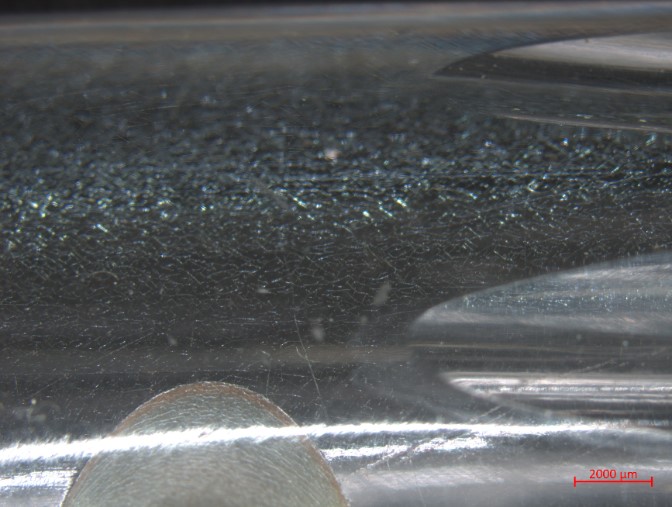
Microscope image of deterioration in the form of microcracking seen through the glass on the interior of a flute by Claude Laurent, dated 1814 (DCM Collection, The Library of Congress).

(Left image) Two-dimensional profile image of severe surface cracking in Laurent flute DCM 1681, dated 1822, taken by non-invasive optical coherence tomography (OCT). Image delineates the hydrated glass surface and shows subsurface cracking through and under this layer. The inset shows the microscope image of the flute glass surface with a red arrow showing the scanned area (across ridge of carved depression). Physical distances in the glass are corrected with refractive index = 1.45. Note that lines of multiple white lines are artifacts.
(Right image) Cross-section of glass microsample taken from DCM 1681 and viewed by backscattered scanning electron microscopy. The image gives similar information to the OCT, where the darker grey surface areas define surface degradation in terms of cracking and depletion of potassium caused by hydration (credit A. Buechele).

(A) Microscope detail of encased daguerreotype and (B) in situ, 3-dimensional OCT image of droplets on underside of its cover glass; the largest droplet, located near the arrow, measures about 100 µm in depth. Note that droplets appear doubled in the microscope image at left due to reflection from the silver mirrored surface.

PDF of a timeline of 19th century glass manufacturing advances and photographic technology (credit Kate Fogle).


