
Chapter 1: America Enters the World Stage: A Visit to the Great Hall
Stop on the first floor to hear an introduction to the Great Hall and the construction of the Thomas Jefferson Building by Matt Leifer, the Library’s Deputy Chief of Visitor Engagement.
Chapter 1: Great Hall
Transcript
Hi. I’m Matt Leifer, the Deputy Chief of the Visitor Engagement Office, here, at the Library of Congress. You are now standing in the Great Hall, on the first floor—the center of this grand building. Take a moment to look around. What interests, excites, or inspires you? What are you curious to know more about? The symbols, references to literature and mythology, and the names of influential figures from history that are depicted here were designed to inspire visitors toward lifelong learning. I’ll talk more about some of these symbols and inscriptions as we go. But, if you are curious about something I don’t discuss, please ask any of our visitor engagement team members in black vests for more information.
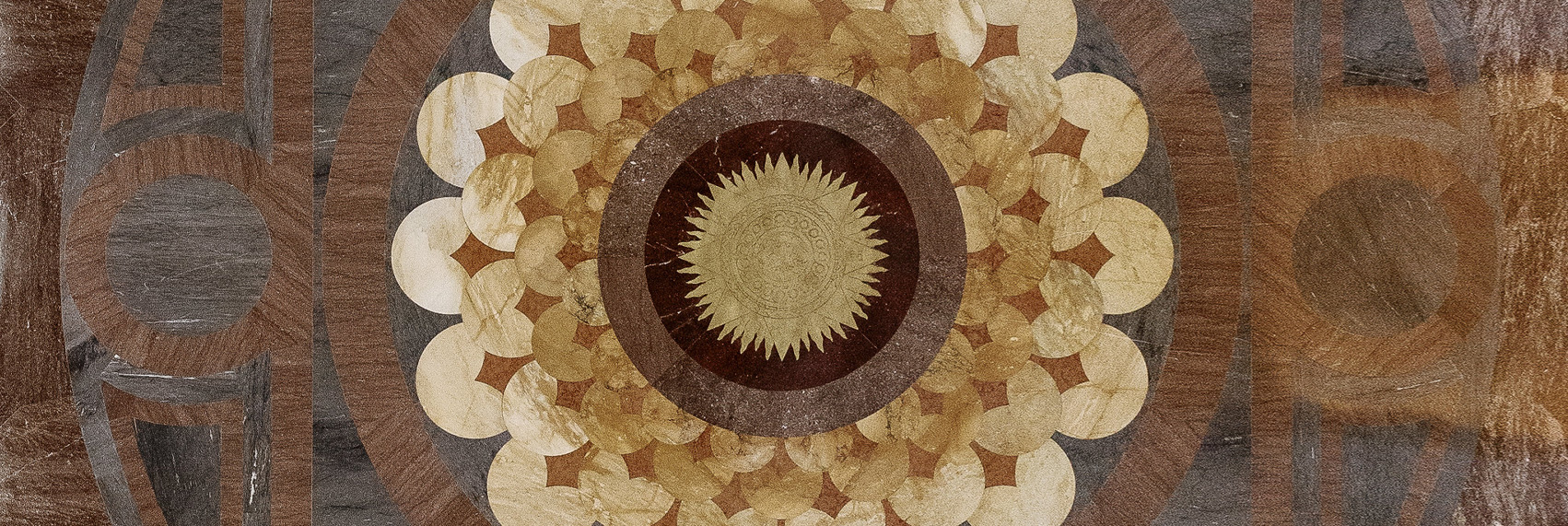
Now, walk into the middle of the hall to the bronze circle on the floor. The decoration below you represents a compass rose. The four points of the compass are directionally accurate; you can use them to orient yourself. They also suggest the idea that the Library and librarians are here to guide you toward information or resources you seek. Turn to the “East” on the compass rose to find the arch at the center of the Great Hall. It has “Library of Congress” written in gold leaf and two figures on either side -- a young man holding a scroll on the left and an older man with a tablet on the right. What do they suggest to you? To me, they bring to mind the idea of life-long learning and that you’re invited to start your research at the Library at any point in your life.
Now, look up and around. The Library of Congress Building opened on November 1, 1897, and its design represents the interests and values of that era. It was the Gilded Age, a time of industrial and scientific growth and technological advances. America’s economic and political influence was growing, as was its role on the international stage. As you look up toward the columns above you, you will see the names of writers and thinkers who were particularly revered in 1897. Some of these figures include authors from Europe, such as Cervantes, Dante and Shakespeare. Others are influential Americans from the 19th century, such as poet Henry Wadsworth Longfellow and diplomat and historian George Bancroft. If you were to create a monument to knowledge and learning today, whom might you choose to memorialize?
Now, do you see the bare lightbulbs near the ceiling and the large bulbs held up by bronze statues at the foot of the stairs? Lightbulbs are an important part of the building’s story—this was the first public building in Washington, DC designed with electricity included. The bulbs celebrate this modern scientific achievement and America’s embrace of new technology. And, how about Thomas Edison, inventor of the incandescent light bulb? Well, he’s represented in the Library’s collection too—his laboratory produced pioneering work in motion pictures, and many of the Edison Company’s early works are preserved here in the Motion Picture, Broadcasting and Recorded Sound Division. You can see some of them on the Library’s website, loc.gov, in a section called the “National Screening Room.” Continue on through the arch to the next section of the tour.