
Chapter 8: The Collecting Library: Thomas Jefferson’s Library
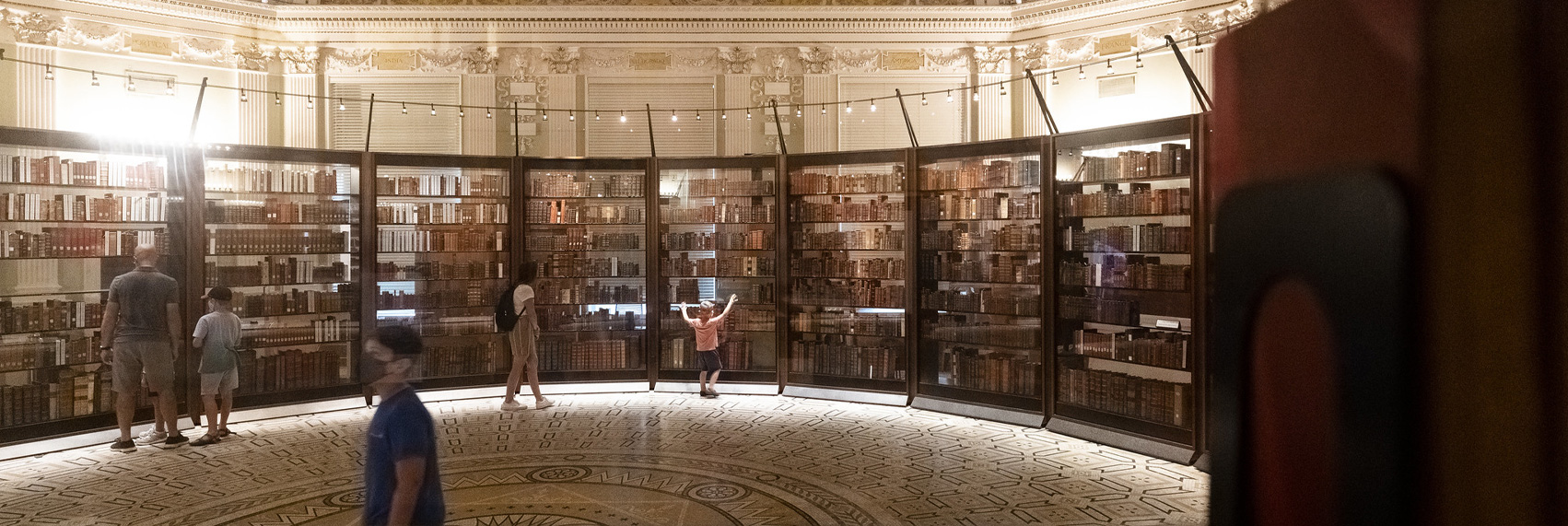
Dr. Stephanie Stillo introduces you to the exhibition of Thomas Jefferson’s library, which was the foundation of the modern Library of Congress.
Chapter 8: Thomas Jefferson’s Library
Transcript
Head through the exhibition gallery—and pause this tour to look around. Press play when you are ready to continue.
In the large room at the end of the exhibition, you’ll find Thomas Jefferson’s Library. This corpus of material connects us with the early history of the Library of Congress and foreshadows its modern role as an institution that collects broadly, across time periods, geographies, formats, and languages.
As my colleague discussed in chapter 7, Thomas Jefferson sold his wide-ranging personal book collection to the nation in 1815, and this is the foundation of the Library today. His collection replaced Congress’ small reference library that was housed in the Capitol building and burned along with it during the War of 1812. This display shows Jefferson’s collection the way he organized it, into three main categories: “Memory,” “Reason” and “Imagination.” If you look around the labelled shelves, you can gain insights into Jefferson’s interests and influences. Some of these books were the sources he had at hand and even consulted as he wrote the Declaration of Independence—a draft of which is preserved here at the Library along with Jefferson’s papers.
Now, do you see the differently colored ribbons placed in many of the volumes? The green ribbons identify original books from Jefferson’s own collection—about 2,000 of the over 6,000 in the original sale. You’re probably wondering what happened to all the other books in Jefferson’s Library. In December of 1851, a fire in the Capitol building destroyed two-thirds of the Library of Congress’s collection, an immeasurable loss that included many volumes from Jefferson’s original library. You’ll be happy to know that the Library now has a sophisticated system in place to ensure no such disaster befalls the national collections again! Fortunately, a catalog of Jefferson’s book collection survived the 1851 fire, so we know exactly what he owned. In addition to the green ribbons, which represent books that survived the 1851 fire, gold ribbons identify books that were bought as replacements. These books are the same titles and from the same period as Jefferson’s originals. The volumes without ribbons are copies of titles owned by Jefferson, but not in his original library. These copies were in the Library’s collection, and we used them to fill important gaps. The white boxes are placeholders for books from Jefferson’s original collection that have yet to be found or replaced. Jefferson’s library remains a working collection open to all researchers interested in the life and library of Thomas Jefferson. Researchers are able to request and consult Jefferson’s volumes in the Rare Book and Special Collections Reading Room on the second floor of the Jefferson Building.
When you’re ready to move on, head back to the large mosaic of Minerva on the mezzanine, and take the stairs up to the Main Reading Room.